
Diamond Education
Emerald vs. Radiant Cut: Differences, Sparkle & Cost
Compare emerald and radiant cut diamonds by sparkle, proportions, color, clarity, face-up size, and cost to find the style that suits your ring.
By Ring Wisdom Editorial TeamPublished Updated
Affiliate disclosure: we may earn a commission from qualifying purchases through links in this article, at no extra cost to you. Learn more.
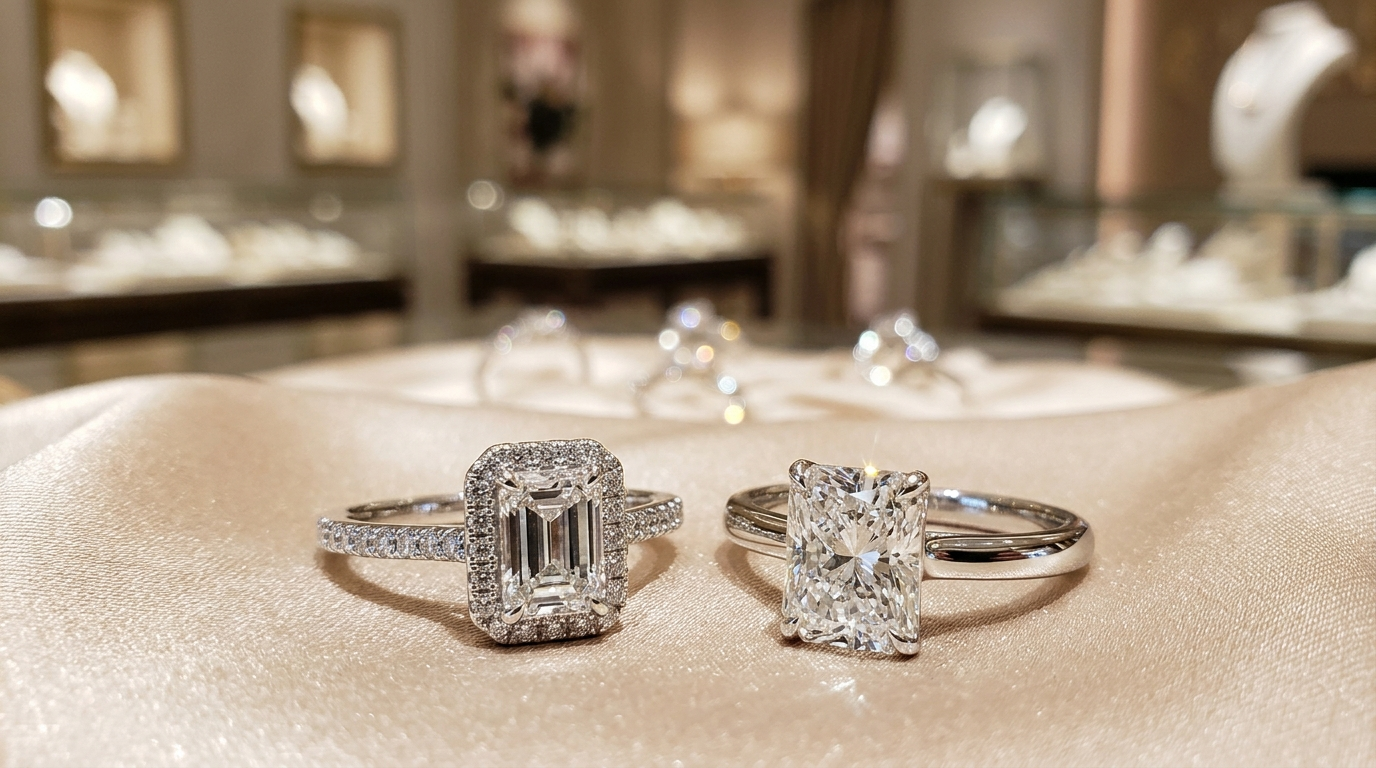
Emerald vs. Radiant Cut: At a Glance
A radiant cut is the stronger choice if you want lively sparkle, while an emerald cut may suit you better if you prefer broad, mirror-like flashes and clean geometry. For an engagement ring, the difference can shape how the ring looks on your hand and how you set your budget.
Neither style is universally better. The right choice reflects your personal taste and what you want to see each day. Use this comparison to weigh appearance and spending without assuming that one cut offers the best value for everyone. Your preferred kind of light is a good first decision to make before comparing individual stones.
- Choose lively sparkle or broad, mirror-like flashes first.
- Compare the actual stone, not just its shape name.
- Check proportions and face-up measurements before choosing.
- Judge color and clarity by what you can see.
- Compare prices only when the diamond and setting details match.
Why the Two Shapes Look Similar From Above
From across a room, both shapes can look like rectangles with clipped corners, even though their facet layouts are built differently. Both may also appear square, depending on their proportions. The radiant combines an emerald-like outline with a brilliant-style facet arrangement.
The emerald cut has a step cut: broad, parallel tiers of facets that reflect light in wide, mirror-like flashes. Emerald cut diamonds originated in the 1500s and gained prominence during the Art Deco period of the 1920s and 1930s. Radiant cut diamonds were developed in the late 1970s. Their shared outline does not mean the two cuts are built to look the same.
Choose a setting for the outline and overall design you want, not as a substitute for choosing the stone’s facet pattern. Either shape can work with a range of engagement ring designs.
- A solitaire keeps the center stone in focus.
- A three-stone design places side stones beside the center.
- An east-west setting turns an elongated stone horizontally.
- A bezel surrounds the stone’s edge with metal.
- A halo frames the center with smaller stones.
Part 1 of 5 complete
How Do Emerald and Radiant Cut Diamonds Handle Light?
If frequent sparkle is your priority, the radiant cut usually gives you more visible activity than the emerald cut. Radiant cuts generally deliver more frequent, energetic sparkle, while emerald cuts return broader, more orderly flashes. The difference comes from how their facets direct light back toward your eye.
Emerald cuts use parallel, tiered facets to return wider areas of light. Their flashes can look like bright panels, with clear lines between them. As the diamond moves, reflections shift across the face rather than breaking into constant tiny points. This creates a composed look that puts the stone’s broad surfaces on display.
A radiant can show crisp flashes alongside smaller reflections known as the crushed-ice effect. Some radiant cuts lean toward defined flashes; others show a finer, more scattered pattern. Watch the diamond move rather than judging a single still view, since two radiants can show different balances of broad flashes and smaller twinkles.
- Emerald cut — parallel tiers; typically 49–58 facets; broad, orderly flashes; a calm, mirror-like look.
- Radiant cut — brilliant-style facet pattern; often more than 70 facets; direct flashes and smaller reflections; generally more frequent sparkle.
Shape, Proportions, and the Bow-Tie Effect
A longer radiant can look elegant, but stretching the outline too far can make its light performance less even. The length-to-width ratio compares the diamond’s length with its width. Rectangular radiant cuts commonly have a ratio of 1.20–1.40, while a perfectly square diamond has a ratio of 1.00. A longer outline is a preference, not an automatic improvement.
Some elongated fancy shapes show a dark pattern across the center called a bow-tie effect. It can appear to varying degrees, and a well-cut stone should keep it subtle and nondistracting. An overly elongated radiant can have light-performance problems, including a stronger bow-tie.
A grading report will not show or describe a bow-tie effect, so assess the individual diamond’s appearance. Judge the bow-tie on the specific stone rather than treating its presence as an automatic reason to reject every elongated radiant.
- View the stone in person if possible.
- Use high-quality video if an in-person view is not possible.
- Check that any bow-tie stays subtle and nondistracting as the stone moves.
How Color and Clarity Show in Each Cut
An emerald cut shows more of the diamond’s interior, so color and inclusions deserve closer attention than they do in a radiant. Its open, broad facets can make warmth or a visible mark easier to notice. A radiant’s busier facets can disguise some color and inclusions. Judge both qualities by the specific stone’s appearance, not by its grade alone.
For a radiant that looks white, G–H is a practical color range to consider. I–J or lower can begin to show yellow, though the appearance depends on the individual diamond and viewing conditions. Brilliant-style facets can help mask some color, but they do not make every stone look identical.
With emerald cut diamonds, the broad, open view gives warmth fewer places to hide. If a white appearance matters to you, compare the actual diamonds side by side rather than relying on a grade in isolation. Metal color can also affect the overall impression of a finished ring.
An inclusion is a natural feature inside a diamond or on its surface. The open facets of an emerald cut may make inclusions easier to see, while a radiant’s more active facet pattern can disguise some of them. Eye-clean describes a stone that looks clear to the unaided eye; it is a visual judgment, not a guarantee attached to a clarity grade. Inspect the specific stone for the appearance you want.
How to Judge a Radiant’s Light Performance
A grading report alone cannot tell you how well a radiant performs in light. GIA assigns an official cut grade only to round brilliant diamonds, using a scale from Excellent to Poor. A radiant report will not provide an equivalent official cut grade, so its grading information offers limited detail about how the stone handles light.
Use visual evidence to assess how the diamond returns light and how its facets appear together. Still images can reveal details, while video shows how the pattern changes as the diamond moves. ASET imaging offers another way to examine light return, but it does not replace looking at the individual stone.
Compare the same diamond across the available views so the images refer to one exact stone. A polished sales photo may not show every detail equally well, so weigh all the visual evidence together. Compare visual evidence for the exact stone you are considering, not just its listed grades.
- Well-lit still images that show the stone clearly.
- Video that shows the diamond from more than one view.
- ASET imaging, which can help assess light return.
Face-Up Size and Measurements
Compare millimeter measurements side by side when face-up size matters more to you than the number of carats. Carat measures weight, so it does not by itself tell you how large a diamond looks from above. Check length and width to compare the visible footprint of each stone.
The example measurements in the article list a 1-carat emerald cut and a 1-carat radiant cut at 7 × 5 mm each. At 2 carats, the listed emerald and radiant dimensions are both 8.2 × 6.2 mm.
Those shared dimensions are a useful starting point, but they do not mean every emerald cut and radiant of the same carat weight will look equally large. Individual proportions and depth can differ, changing how much of each stone shows from above.
A wider outline can cover more of your finger, while a deeper stone can carry more weight below the surface. Check the exact stone’s length and width before deciding whether it gives you the finger coverage you want.
Cost Depends on the 4Cs and Ring Type
Compare prices only after matching carat weight, color, clarity, and whether the quoted amount includes a setting. Price depends on the 4Cs and on whether you are buying a loose diamond or a finished ring. A diamond price and a ring price are not like-for-like amounts.
The following examples are price references stated in the source article for 2026. Prices can change, and the examples describe different products, so they should not be treated as a direct ranking between the two shapes.
The emerald cut diamond example covers a loose stone, while the solitaire example includes a 14K gold setting. The radiant cut diamonds span a broad range, with price varying by the 4Cs. Lab-grown diamonds in either shape can sit at very different price points.
- Emerald-cut lab-grown diamond: 1 carat, G color, VS2 clarity; loose diamond only; approximately $650–$1,300 (2026 example).
- Emerald-cut lab-grown solitaire ring: 2 carats, F color, VS1 clarity, 14K gold; finished ring and setting; listed from $1,095 (mid-2026 example).
- Radiant-cut lab-grown diamonds: diamond prices, not finished rings; $210–$26,000 range, with a $2,300 median (2026 example).
- Treat any listed price as a starting point for comparing equivalent stones and ring components, not as a direct price ranking between the two shapes.
Conclusion
The right choice is the one whose look you will enjoy seeing on your hand every day. An emerald cut may suit you if you want a more composed appearance; a radiant may fit your taste if you prefer more lively sparkle. Your engagement ring should reflect your preferences, not a rule about which shape is best.
Before deciding, consider how each stone looks in a setting you would actually wear. Compare appearance and cost using the details of the exact diamonds, then choose the one that feels right for your style. If you are still undecided, view an emerald and a radiant side by side in the same lighting before choosing your ring.
Keep learning: read the Diamond Buying Guide, explore diamond shapes and the diamond 4Cs, browse comparisons, or see all buying advice.
Frequently asked questions
Can you wear a radiant cut diamond every day?
Yes, you can wear a radiant cut diamond every day. Its clipped corners help protect the outline compared with a shape with pointed corners, though they do not make the stone impossible to damage. The setting also matters: secure prongs or a protective bezel can help shield the edges. Have the setting checked regularly, especially if you wear the ring often.
What setting can help protect the corners of an emerald or radiant cut?
A bezel or a setting with well-positioned prongs can help protect the exposed corners of an emerald or radiant cut. A bezel wraps metal around the stone’s edge, while prongs hold it at selected points. The right design depends on the stone’s precise dimensions and the ring’s overall style. Ask to see how the setting covers each corner before choosing.
Can you choose a ring setting before buying the center stone?
Yes, you can choose a setting style before buying the center stone, but the setting must fit the stone you select. Its shape and precise measurements affect how the center sits and how securely the setting holds it. A setting chosen too early may need adjustment or replacement if the diamond’s dimensions do not match. Confirm fit before the ring is completed.
How can you compare radiant diamonds when shopping online?
Use clear still images and video that shows each radiant diamond from multiple views. Compare the same stone across those views, rather than judging one diamond from a report and another from a photograph. Look for images that show the full face and video that reveals the pattern as the stone moves. This gives you a more useful view of the individual diamond.
Does yellow gold change the color grade of a diamond?
No, yellow gold does not change a diamond’s color grade. The grade describes the diamond, while the metal can change the overall color impression of the finished ring. Yellow gold may create a warmer contrast around a white-looking stone. Compare the diamond in the setting or metal color you plan to wear, since the finished ring can look different from the loose stone.
Is the crushed-ice effect the only pattern a radiant can show?
No, the crushed-ice effect is not the only pattern a radiant can show. A radiant can combine smaller twinkles with direct flashes, and individual stones vary in how much of each you see. One may look more defined, while another may appear more scattered. Compare the actual diamonds in motion to find the balance of reflections you prefer.
Related articles
Diamond Education
The 4Cs of Diamond Quality: A Practical Buyer's Guide
How cut, color, clarity and carat weight affect a diamond's look and price, and a step-by-step way to decide which grades are worth paying for.
Updated November 13, 2026
Budget Planning
How Much Should You Spend on a Ring? A Practical Budget Guide
Learn how to create a realistic engagement ring budget, compare natural and lab-grown diamonds, understand setting costs and avoid expensive financing mistakes.
Updated November 11, 2026