
Diamond Education
Gemological institute of america diamond grading report guide
Learn what a GIA diamond grading report records and how to read its grades, clarity plot, fluorescence, and report number. Use the report alongside an in-person inspection when comparing diamonds.
By Ring Wisdom Editorial TeamPublished Updated
Affiliate disclosure: we may earn a commission from qualifying purchases through links in this article, at no extra cost to you. Learn more.
Key Takeaways
A GIA diamond grading report records a diamond’s identity and gemological grades. It provides a consistent reference for comparing recorded characteristics, but it is only one part of a buying decision. Your preferences and the diamond’s appearance matter, too.
- Use the report as a record of gemological observations.
- Compare the 4Cs as a group, not as a single score.
- Check that the report details match the diamond you see.
- A report does not set a diamond’s market price.
- Look at the stone in person before choosing it.
What Does a GIA Grading Report Tell You?
A GIA diamond grading report records gemological characteristics, not a market price. Its report number can help you identify the record and connect it with the diamond you are considering.
Different documents answer different questions. A grading report describes the diamond, an appraisal estimates monetary value for a stated purpose, and a sales receipt records details of a transaction. These documents are not interchangeable when you compare stones, arrange insurance, or confirm a purchase.
An appraisal and a receipt may include information beyond the report, but neither serves the same grading role. A GIA report number lookup can help you find the report’s online details; the number identifies the report record, not the diamond’s current market value.
Keep your records together after a purchase. Each can be useful for a different task, so use the document that matches the question you need answered.
- GIA grading report: records gemological characteristics and grades.
- Appraisal: estimates monetary value for a stated purpose.
- Sales receipt: records details of a completed transaction.
Part 1 of 7 complete
How to Read a Gemological Institute of America Diamond Grading Report
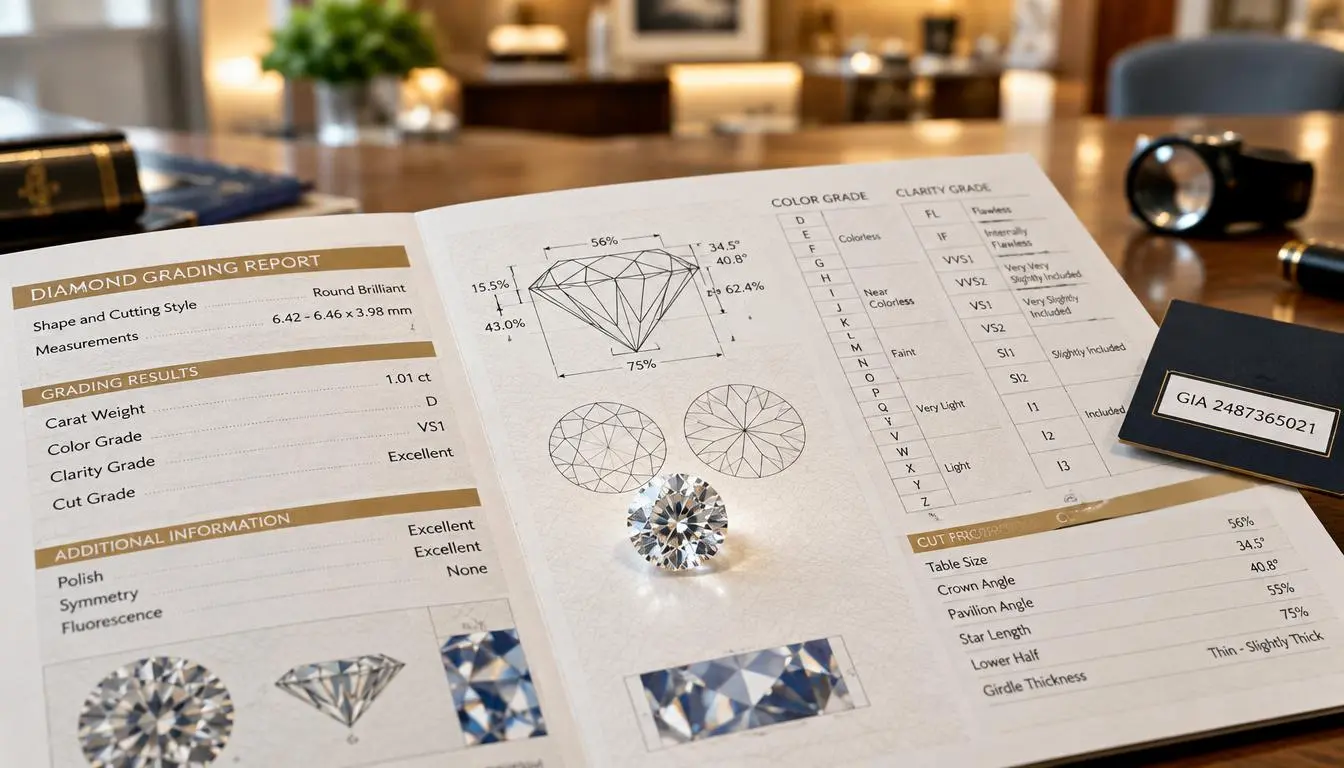
Start with the report number and date, then use the diamond description to confirm that you are reading the record for the stone in front of you. Check the identity fields before relying on any grade. The layout can vary by report type, so field placement may differ.
The report number identifies the record, while the report date shows when GIA issued it. Find the shape and measurements in the diamond description and compare those details with the stone. Read the diamond type designation as it appears on your report rather than expecting every format to use identical wording.
The 4Cs fields cover carat weight, color, clarity, and cut. Other report details may include a clarity plot, fluorescence, comments, and inscription information when applicable. Some report types include different fields or arrange them in a different order.
The report date and number serve different purposes: one records when the report was issued, and the other identifies its record. Checking the identifying details first can help prevent comparing a grade from one report with the wrong diamond.
- Confirm the report number and report date.
- Compare the diamond’s type, shape, and measurements with the stone.
- Locate the 4Cs grades and any supporting details, such as the clarity plot or fluorescence field.
- Follow the labels on your specific report; layouts can vary.
How Are the 4Cs Represented on a GIA Report?
The 4Cs describe different characteristics, so read a carat measurement differently from a color, clarity, or cut grade. Carat weight is a measurement; the other listed fields are grades or quality information. Compare the fields as a group rather than treating one strong grade as a guarantee of overall appearance.
GIA grades diamond color on a scale from D to Z and clarity from Flawless (FL) to Included 3 (I3). These scales describe different traits: a color grade cannot stand in for a clarity grade.
The clarity field gives a grade, while the clarity plot shows approximate locations and types of marked characteristics. The plot supports the grade’s description but is not another grade.
Carat weight records how much the diamond weighs. Cut information describes a quality category, and GIA’s cut grade applies to round brilliant diamonds. A larger carat value does not, by itself, tell you how a diamond will look face-up.
- Carat weight: the diamond’s weight.
- Color: a grade on GIA’s D-to-Z scale.
- Clarity: a grade on GIA’s FL-to-I3 scale.
- Cut: a cut grade when applicable, including for round brilliant diamonds.
Read the Clarity Plot Without Overreading It
A clarity plot is a schematic map of marked characteristics, not a magnified picture or photograph of the diamond. Use it to locate features, not to predict exactly how visible they will be.
Read the plot key before comparing its marks with the stone. Symbols stand for types of clarity characteristics, and their positions show approximate locations. The plot can guide your inspection, but it cannot show every detail of the diamond’s appearance.
The marks are not a scale of visibility, and the plot alone cannot tell you whether an inclusion will stand out to your eye. Use suitable magnification to compare the listed features with the actual diamond, then judge the stone itself.
- Locate and read the plot key.
- Identify the symbols used.
- Note where the plotted characteristics appear.
- Compare the diagram with the diamond under magnification.
Interpret the Cut Grade and Proportions
A GIA cut grade gives you a cut-quality category for a round brilliant diamond, while its proportions provide additional measurements. The GIA cut-grade scale has five grades, from Excellent to Poor; it does not apply to every diamond shape.
The categories help you compare round brilliant diamonds, but they do not replace looking at each stone. A grade can narrow your comparison, while the diamond’s visible appearance shows how the cut looks to you.
Proportions are recorded measurements, not another grade. They provide extra detail about the diamond’s dimensions. A fancy-shape diamond may have measurements but no GIA cut grade, so assess its proportions and appearance rather than expecting a round brilliant cut grade.
- Excellent — highest of the five grades.
- Very Good — second of the five grades.
- Good — third of the five grades.
- Fair — fourth of the five grades.
- Poor — lowest of the five grades.
What Does Fluorescence Mean for Your Choice?
The fluorescence field describes how strongly a diamond responds to ultraviolet light; it is separate from the 4C grades. GIA uses five intensity categories: None, Faint, Medium, Strong, and Very Strong.
The category records the strength of the response to ultraviolet light. It does not tell you whether you will like the diamond’s appearance, and the word “Strong” alone does not establish whether a stone looks appealing to you.
Compare the diamond face-up in lighting similar to the places where you expect to wear it. Look at the whole stone rather than focusing only on the report entry. When possible, inspect it in more than one setting, since lighting can change what you notice. Make your decision based on the diamond’s appearance in real viewing conditions, not the fluorescence label alone.
Verify the Report Number and Inscription
A report-number lookup checks the record, while a matching girdle inscription can help connect that record to the diamond. GIA Report Check is GIA’s online report lookup service. Use these checks when relevant, but do not treat either as a complete guarantee.
Enter the report number in the online service, then compare the record with the document and the stone. When present, a laser inscription sits on the diamond’s girdle and can be checked under magnification.
Not every diamond has an inscription, so its absence does not by itself show a problem. The online details and the diamond’s physical features still need to agree. If the report and online record differ, pause the purchase until the report and stone can be checked together.
- Enter the report number in GIA Report Check.
- Compare the online record’s diamond details with the report.
- If the diamond has a laser inscription, check the girdle under magnification.
- Treat an inscription as one identity check, not proof that every detail is correct.
Confirm Natural or Laboratory-Grown Identity
Check the diamond type stated on the report before comparing its grades with another stone. GIA reports identify whether a diamond is natural or laboratory-grown. These are distinct growth-origin categories, not different grades on one scale.
Read the identification language in the report’s diamond type or description field. Formats and terms can differ, so use the wording printed on that specific document rather than inferring the type from appearance or other grades.
The designation tells you whether the diamond is natural or laboratory-grown. It does not establish a specific mine, the route the stone took, or its full supply-chain history. Those claims require information beyond a growth-origin category.
The type designation also does not replace checking the physical stone against its record. Shape, measurements, and other identifying details still matter.
Compare the Report Details With the Diamond You See
Two diamonds with similar report grades can still look different. Recorded grades cannot replace an in-person view of the diamond; shape, measurements, and appearance provide details that a group of grades cannot capture alone.
Compare the report’s shape and measurements with the diamond in front of you. Use the clarity plot as a locating aid while inspecting the stone, rather than relying on the diagram by itself. Small differences in shape or dimensions can affect how two diamonds look beside each other.
Viewing conditions and personal preferences matter alongside grades. Compare candidate diamonds in the same lighting, and take time to view the actual stone rather than relying only on a listing or report. Choose the diamond whose documented details and in-person appearance fit your priorities.
- Confirm the shape.
- Compare the measurements.
- Inspect the stone face-up.
- Compare shortlisted diamonds in the same lighting.
What If Your Report Is Lost or Damaged?
If your paper report is missing, locate its report number if possible and ask GIA which replacement options apply. A replacement request is separate from a new grading evaluation, and available options depend on the report record and GIA’s current process.
Gather the information you have about the report and diamond before contacting GIA. Confirm current requirements through GIA’s official service channels before sending a diamond or requesting a replacement.
If you still have access to the report number, keep a note of it in a separate, secure place. It may make it easier to identify the record later.
- Gather the report number if it is available.
- Identify the report type and the diamond.
- Contact GIA through its official service channels to ask about eligibility and requirements.
- Confirm current process details directly with GIA.
Know What the Report Cannot Tell You
A grading report describes the diamond’s recorded characteristics, but it cannot show everything about the complete piece of jewelry. It does not assess the setting or guarantee how the diamond will look in every light.
A report does not establish the diamond’s current wear condition or tell you whether its appearance suits your taste. Laboratory observations and your own inspection answer different questions.
A mounted diamond may be harder to view from some angles, and the setting can affect how you see the stone. Give the complete piece a close look, check that the setting looks sound, and make sure the diamond’s present condition meets your expectations.
Conclusion
A GIA report is most useful when you can connect its grades to the exact diamond you are considering. The report number helps identify the record, but the document and physical stone need to match.
Before you buy, check the report number and compare the report with the diamond in front of you. Let your decision reflect both the recorded details and what you see in person.
Keep learning: read the Diamond Buying Guide, explore diamond shapes and the diamond 4Cs, browse comparisons, or see all buying advice.
Frequently asked questions
Do GIA diamond grading reports expire?
A grading report records observations made when it was issued; it is not a statement of the diamond’s current condition. If you need to confirm a report record, use its number with GIA Report Check.
Can two diamonds with the same GIA grades look different?
Yes. Similar grades do not capture every difference in shape, proportions, dimensions, or face-up appearance. Compare the actual diamonds in person and, where possible, under the same lighting.
Can you use a GIA report for insurance?
A GIA report records gemological characteristics and grades, not a monetary value. An insurer may require other documentation, such as an appraisal; check the insurer’s requirements.
Does a GIA report show where a natural diamond was mined?
The natural-diamond designation identifies growth origin, but it does not establish a specific mine or the diamond’s full supply-chain history.
Can a GIA report tell you whether a diamond is real?
A GIA report records the identity and gemological characteristics of the diamond it describes. To connect a report with a particular stone, compare the report details with the diamond and verify the report number; do not rely on the document alone as a complete guarantee.
What is the difference between a GIA report and a diamond certificate?
The article refers to a GIA grading report as a record of gemological characteristics and grades. The term “certificate” is sometimes used informally, but check the document itself to understand what it records; a grading report is not an appraisal or a statement of market value.
Related articles
Diamond Education
The 4Cs of Diamond Quality: A Practical Buyer's Guide
How cut, color, clarity and carat weight affect a diamond's look and price, and a step-by-step way to decide which grades are worth paying for.
Updated November 13, 2026
Budget Planning
How Much Should You Spend on a Ring? A Practical Budget Guide
Learn how to create a realistic engagement ring budget, compare natural and lab-grown diamonds, understand setting costs and avoid expensive financing mistakes.
Updated November 11, 2026