
Diamond Education
Diamond Clarity Chart: How to Read Diamond Grades
Understand the 11 GIA diamond clarity grades, what inclusions and blemishes mean, and how to compare a report with the stone you may buy. Learn why the highest grade is not automatically the right choice.
By Ring Wisdom Editorial TeamPublished Updated
Affiliate disclosure: we may earn a commission from qualifying purchases through links in this article, at no extra cost to you. Learn more.
Key Takeaways
The GIA diamond clarity chart organizes 11 grades, from Flawless to Included, according to characteristics a skilled grader can see under 10× magnification. Use the grades to compare stones, then evaluate the appearance of the individual diamond.
- The GIA clarity scale has 11 grades, from FL to I3.
- Clarity grades describe characteristics seen under 10× magnification.
- A higher grade does not always look better to you.
- Many diamonds offered in stores fall in the VS or SI categories.
- Compare the actual stone as well as its grade.
What Does Diamond Clarity Measure?
A clarity grade reflects characteristics a skilled grader can see when examining a diamond under 10× magnification. Clarity assesses inclusions, which are internal characteristics, and blemishes, which are external characteristics. GIA evaluates how these features appear; clarity alone does not describe the diamond’s overall quality.
GIA considers five factors together: size, nature, position, color or relief, and quantity. Relief describes how strongly a characteristic contrasts with the surrounding diamond. A small feature may stand out more than a larger one if it has stronger contrast or sits in a noticeable position.
Magnification gives the grader a consistent view, but a report cannot replace your own assessment of the stone’s appearance.
- Size: how large the characteristic appears.
- Nature: whether it is internal or on the surface, and its general type.
- Position: where it sits within or on the diamond.
- Color or relief: how strongly it contrasts with the surrounding material.
- Quantity: how many characteristics appear and how they are distributed.
Part 1 of 6 complete
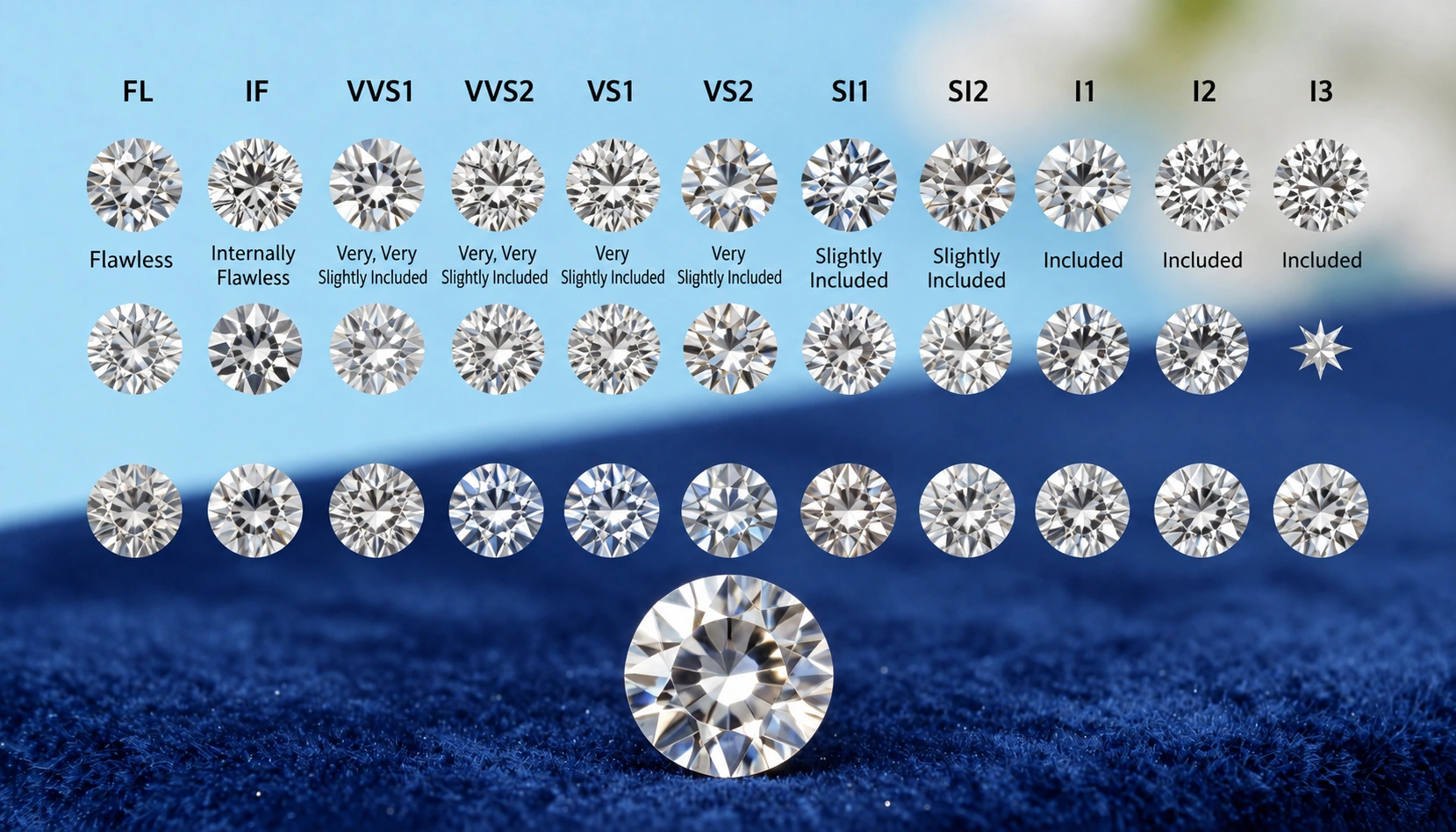
Diamond Clarity Chart: All 11 GIA Grades
GIA’s 11 clarity grades are grouped into FL, IF, VVS1, VVS2, VS1, VS2, SI1, SI2, I1, I2, and I3. The descriptions refer to what a skilled grader sees under 10× magnification; they do not mean every diamond in a grade looks identical.
FL means no inclusions or blemishes are visible to a skilled grader under 10× magnification. IF means no inclusions are visible, though blemishes may be present. VVS inclusions are very difficult to see, while VS inclusions range from difficult to somewhat easy to see.
SI inclusions are noticeable to a skilled grader at 10×. I-grade inclusions are obvious and may affect transparency and brilliance. These descriptions refer to magnified grading, not a guarantee of how a diamond looks without magnification.
- FL / IF: FL has no visible inclusions or blemishes; IF has no visible inclusions, though blemishes may be present.
- VVS1 / VVS2: inclusions are very difficult to see under 10× magnification.
- VS1 / VS2: minor inclusions range from difficult to somewhat easy to see.
- SI1 / SI2: inclusions are noticeable to a skilled grader at 10×.
- I1 / I2 / I3: inclusions are obvious and may affect transparency and brilliance.
Common Inclusions and Surface Blemishes
A pinpoint is a tiny dot inside a diamond, while a scratch is a mark on its surface. Inclusions are internal characteristics; blemishes occur on the surface. Both can contribute to a clarity grade, but their names alone do not tell you how noticeable they will be in everyday viewing.
Internal characteristics include crystals, pinpoints, needles, clouds, feathers, and graining. Crystals are mineral features inside the diamond; needles are narrow, elongated inclusions; and clouds are clusters of pinpoints that may look like a hazy area. A feather is a fine crack-like feature, while graining refers to lines or patterns formed by irregular crystal growth.
Surface blemishes include scratches, chips, nicks, and pits. A natural is a small remnant of the original rough diamond left on the finished stone. Identify whether a mark is internal or on the surface before using it to interpret a grade.
- Internal characteristics: crystals, pinpoints, needles, clouds, feathers, and graining.
- Surface blemishes: scratches, chips, nicks, and pits.
- A characteristic’s location and contrast can affect how noticeable it appears.
What Eye-Clean Means in Everyday Viewing
A diamond is described as eye-clean when you cannot see inclusions without magnification during ordinary viewing. Eye-clean is not a GIA grade, and the term is subjective because eyesight and viewing conditions differ.
A practical viewing distance is about 8–12 inches in neutral daylight or LED lighting. Look at the diamond as you normally would, rather than searching through a loupe for features you would not notice while wearing it.
A mark visible under 10× magnification may disappear at a normal viewing distance, while another may remain visible. The clarity grade alone cannot tell you which result you will see. Direct spotlights can exaggerate marks with sharp reflections, so try to view the diamond under more than one ordinary lighting condition.
Why Higher Clarity Grades Cost More
Higher clarity grades generally cost more because diamonds with fewer visible characteristics are rarer. Clarity is one of the GIA 4Cs, alongside cut, color, and carat weight. As a general pattern, higher clarity categories are less common and tend to command higher prices.
A clarity grade does not describe the exact face-up appearance of a particular stone. Two diamonds with different grades may look similar to you, while two diamonds with the same grade may show their features differently.
The 4Cs work together when you compare quality and value. A buyer who is comfortable with a lower clarity grade may choose to put more of the budget toward another priority. Treat a clarity premium as a choice about rarity, not an automatic promise of a more beautiful-looking diamond.
- FL / IF: rarest clarity group; generally the highest price range.
- VVS: very rare; generally high price range.
- VS: generally less rare and less expensive than VVS.
- SI: generally less rare and less expensive than VS.
- I: lower clarity categories; inclusions are obvious under 10× magnification.
How to Read a GIA Diamond Grading Report
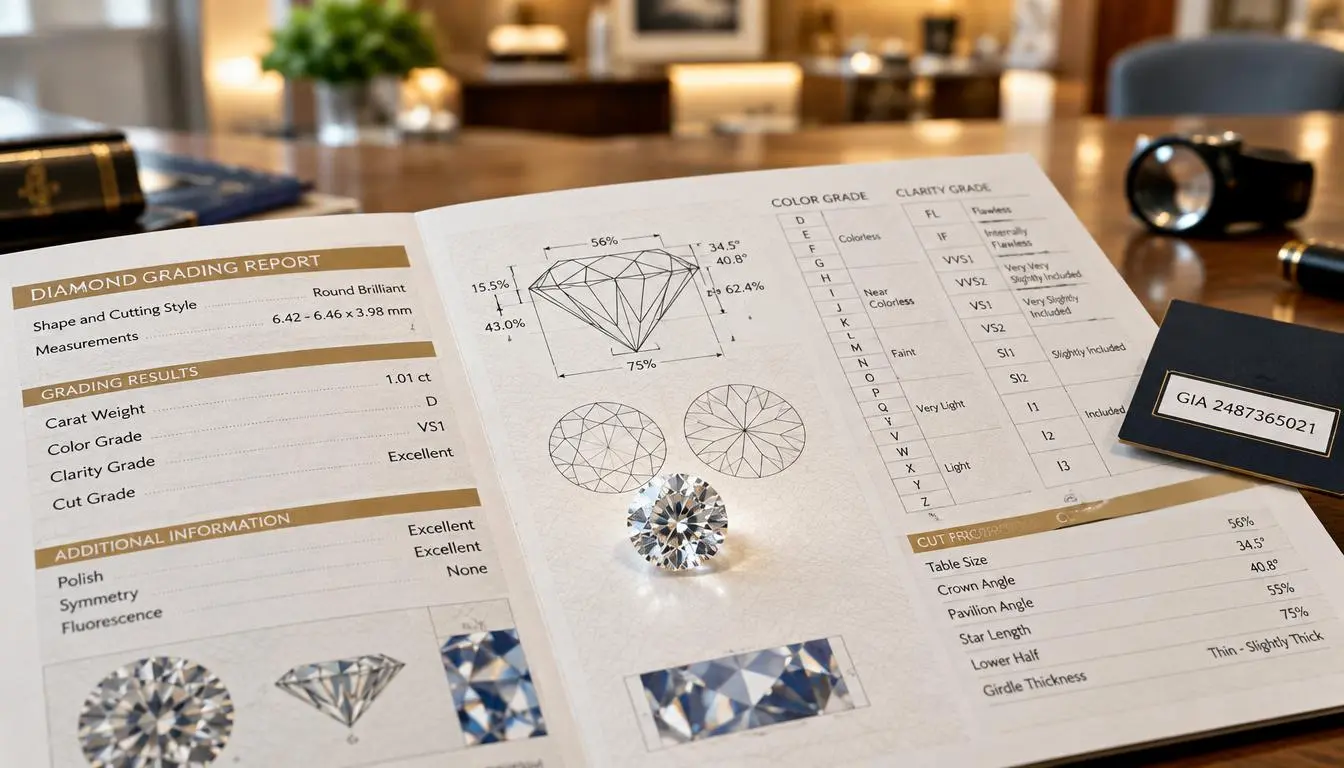
A GIA report places the clarity grade alongside information that helps explain the characteristics behind it. Start with the grade, then use the report details to understand how the diamond was assessed.
Clarity grading considers the number, size, relief, nature, and position of internal inclusions and surface blemishes. Some report formats include a clarity report diagram, also called a plotted diagram, which uses symbols to represent relevant characteristics.
The plotted diagram maps characteristics on the diamond; it does not show exactly how prominent they will look in ordinary viewing. Not every GIA report format includes a plotted diagram. When one is present, read its symbols using the report’s key rather than guessing from their appearance.
The report number can be used with GIA Report Check to access report results. Confirm that the number and report belong to the particular diamond you are considering, especially when a seller is showing several stones.
- Locate the clarity grade shown on the report.
- If the report includes a plotted diagram, match each symbol to its key.
- Use the report number with GIA Report Check to access report results.
- Compare the report with the specific diamond you are evaluating.
How Carat Size and Cut Shape Visibility
A dark mark may be easier to notice in a larger stone than in a smaller stone with a similar grade. Carat weight and visible size are related, but they are not the same measure. The characteristic’s position and contrast matter too; a dark feature near the center may draw more attention than a faint one near the edge.
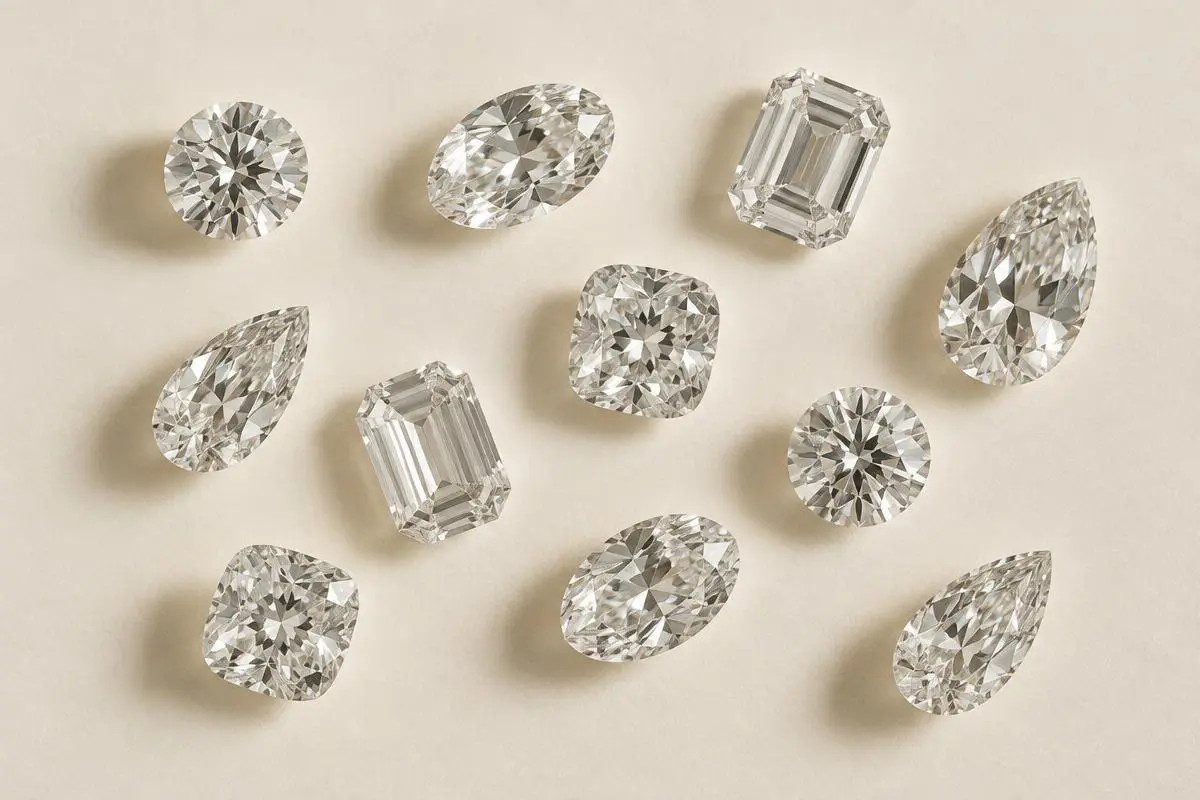
The shape and cut affect how the diamond’s facets handle light, which can change how easy it is to notice a feature. Round and cushion diamonds are examples of brilliant cuts. Emerald and Asscher are step cuts with larger, open facets, which can make some features easier to notice.
Shape is not a fixed clarity recommendation. A VS1 or VS2 diamond may look different depending on its characteristics and cut. Compare the specific stone rather than assuming its grade predicts exactly what you will see.
- Round: brilliant-style facets create a pattern of light and dark areas.
- Cushion: brilliant-style facets may break up the view of a characteristic.
- Emerald: larger, open step-cut facets can make features easier to notice.
- Asscher: larger, open step-cut facets can make features easier to notice.
Inspecting a Specific Diamond Before Buying
Two stones with the same clarity grade can look different when viewed side by side. Use the report as a grading reference, then assess the actual stone. A plotted diagram is useful for understanding the grading, but it cannot show the diamond’s full face-up appearance.
A high-resolution image or 360-degree video may add useful detail when an in-person view is not available, but neither replaces seeing the diamond in person. Compare what you see with the GIA report for that particular stone.
- Inspect the stone without magnification.
- Inspect it with a jeweler’s loupe or a 10× tool.
- Compare the diamond with its GIA report.
- Use a high-resolution image or 360-degree video if you cannot view it in person.
- Make the final visual check on the individual diamond you intend to buy.
Clarity’s Effects on Brilliance and Durability
Cut generally has more influence on a diamond’s sparkle than clarity does when inclusions are not disrupting the stone’s appearance. Cut affects how the diamond handles light; clarity describes characteristics within or on the diamond.
Obvious inclusions can affect transparency and brilliance. GIA notes that I1, I2, and I3 inclusions may affect these qualities, but diamonds in the same grade can look different. The actual characteristics of the individual stone determine what you see.
Some inclusions may raise questions about durability, particularly when a stone has obvious characteristics. A clarity category alone does not establish that every diamond in that category has the same concern. Consider the feature and its location on the individual stone.
Choosing a Clarity Grade for an Engagement Ring
VS2 and SI1 can be useful starting points for buyers balancing appearance and value, but no single grade suits every person or every diamond. Choose according to your priorities and the individual stone, not a universal ranking.
Some buyers prioritize very high clarity or rarity and are willing to pay for it. Others may prefer to direct more of their budget toward another feature. SI1 or SI2 may suit you if the specific diamond meets your visual preferences.
The grade describes characteristics seen during grading; your choice should reflect what you notice and value in the finished ring. Choose the lowest grade that still meets your own visual and budget priorities.
- Start by comparing VS2 or SI1 if you are balancing appearance and value.
- Consider VVS, IF, or FL if very high clarity or rarity is a priority.
- Evaluate an SI diamond in person before deciding whether its appearance suits you.
Conclusion
The best clarity choice is the one that fits your priorities and looks right to you. Use the diamond clarity chart to understand the grades, then judge the stone you may actually wear rather than pursuing the highest grade by default.
The chart can narrow your choices, but the individual diamond should guide your final decision. Compare the specific stone with its grading report and view it in ordinary lighting before you buy.
Keep learning: read the Diamond Buying Guide, explore diamond shapes and the diamond 4Cs, browse comparisons, or see all buying advice.
Frequently asked questions
Is an SI1 diamond eye-clean?
Some SI1 diamonds may look eye-clean, while others may have inclusions visible without magnification. It depends on the characteristics and their position, as well as your eyesight and viewing conditions. Inspect the specific stone at a normal viewing distance.
Are lab-grown diamonds graded on the same clarity scale as mined diamonds?
Lab-grown diamonds can be graded using the same clarity scale categories. Check the grading report to confirm the diamond type and the grading details for the specific stone.
Can diamond inclusions get worse over time?
Inclusions are characteristics within the diamond and do not normally change simply with time. However, the diamond can be damaged during wear, so have it checked by a qualified jeweler if you notice a new chip or other change.
Does clarity affect a diamond’s carat weight?
No. Clarity and carat weight are separate characteristics. Carat measures a diamond’s weight, while clarity describes inclusions and blemishes observed during grading.
Can two diamonds with the same clarity grade look different?
Yes. Diamonds with the same grade can have characteristics that differ in size, type, position, contrast, and visibility. Compare the actual stones rather than relying on the grade alone.
Is a VS1 grade worth choosing over VS2?
It depends on your priorities and whether you can see a difference in the specific stones. VS1 is a higher clarity grade, but it may not look noticeably different to you from a particular VS2 diamond. Compare both stones and consider whether the price difference is worthwhile to you.
Related articles
Diamond Education
The 4Cs of Diamond Quality: A Practical Buyer's Guide
How cut, color, clarity and carat weight affect a diamond's look and price, and a step-by-step way to decide which grades are worth paying for.
Updated November 13, 2026
Diamond Education
Gemological institute of america diamond grading report guide
Learn what a GIA diamond grading report records and how to read its grades, clarity plot, fluorescence, and report number. Use the report alongside an in-person inspection when comparing diamonds.
Updated November 7, 2026