
Diamond Education
Diamond Fluorescence: Which Grade Fits Your Diamond?
Learn what diamond fluorescence grades mean, how fluorescence can look under different lighting, and what to check before you buy. Compare the actual stone rather than relying on its grade alone.
By Ring Wisdom Editorial TeamPublished Updated
Affiliate disclosure: we may earn a commission from qualifying purchases through links in this article, at no extra cost to you. Learn more.
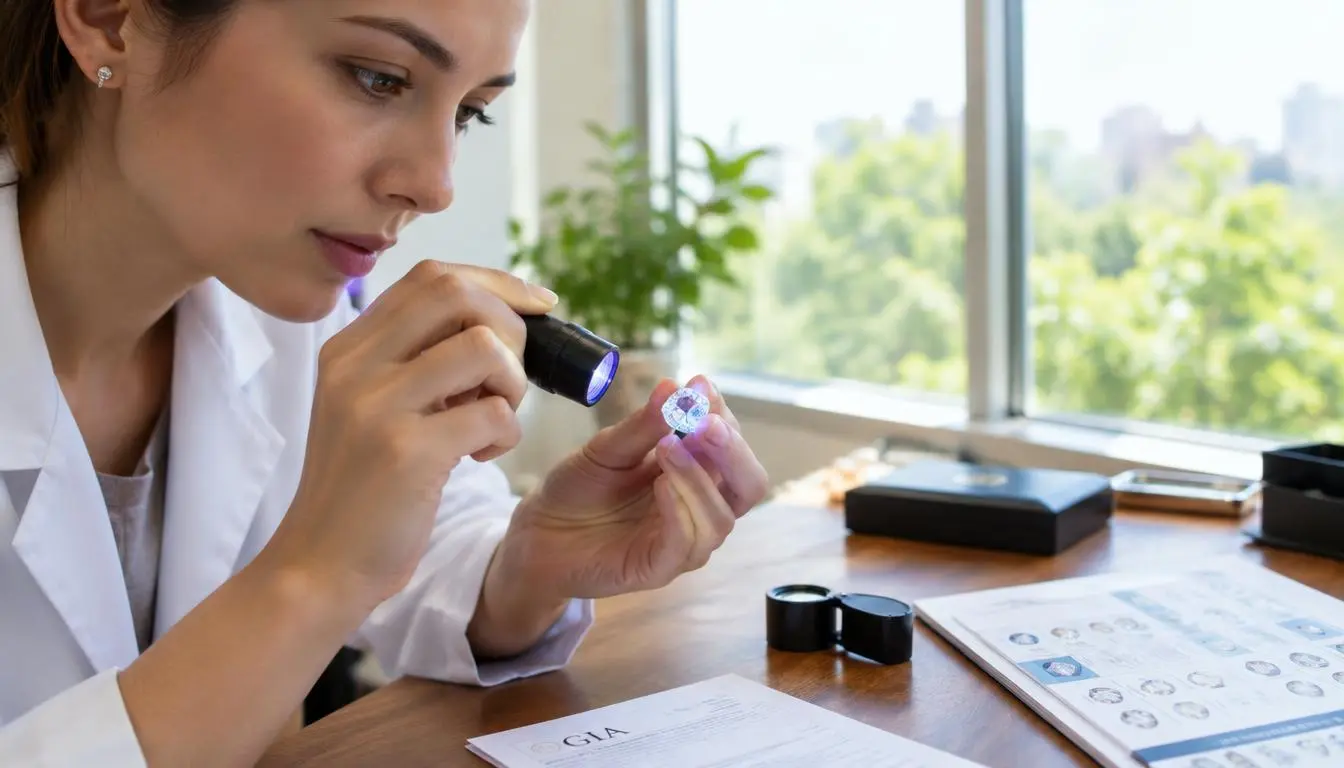
Key Takeaways
No fluorescence or faint fluorescence can be a straightforward starting point, but the right choice depends on the individual diamond and the look you prefer. A grading report records fluorescence; it cannot predict exactly how the stone will appear in every setting.
- GIA uses five fluorescence strength grades: None, Faint, Medium, Strong, and Very Strong.
- A stronger grade can still suit you if you like the individual stone’s appearance.
- Some diamonds emit visible light under ultraviolet (UV) exposure.
- Fluorescence strength and color are separate details.
- Compare the diamond’s appearance and asking price with similar stones.
- Your preference matters more than the grade alone.
How Fluorescence Appears on a Grading Report
A fluorescence grade describes how strongly a diamond reacts under ultraviolet (UV) light. It is not a cut or clarity grade. Fluorescence strength and color are separate details, and a report may record both.
GIA uses five fluorescence strength grades: None, Faint, Medium, Strong, and Very Strong. They describe observed fluorescence under grading conditions, not the diamond’s overall quality or beauty. A report entry may include a strength and a color, such as “Medium Blue.”
Strength indicates the relative intensity of the observed reaction, while color names its hue. Blue is common, but another color may be noted when observed. Read the strength and color together when both appear on the report; neither is a verdict on the stone.
- None — no fluorescence observed under the grading conditions.
- Faint — a very weak reaction.
- Medium — a moderate reaction.
- Strong — a strong reaction.
- Very Strong — the strongest category in this scale.
Part 1 of 5 complete
Blue Fluorescence Under UV and Daylight
Blue is the fluorescence color most commonly discussed, but it is easiest to see when ultraviolet light is present. Fluorescence is visible emission during UV exposure; it does not continue glowing after the light source is removed.
Sunlight includes ultraviolet radiation, while indoor bulbs vary in how much UV they emit. A diamond may fluoresce under a UV source without looking visibly blue in typical indoor lighting.
Blue is not the only possible fluorescence color. Diamonds may also show yellow, green, orange, or, less commonly, white fluorescence. The shade and brightness you see depend on the stone and the UV reaching it.
A UV inspection lamp may make a reaction easier to notice than ordinary room lighting, but that view does not represent every setting. Do not assume a diamond’s fluorescence color will be obvious in every room.
- Blue
- Yellow
- Green
- Orange
- White may also occur, though it is less often discussed.
How Does Diamond Fluorescence Affect Appearance?
Fluorescence can affect a diamond’s visible appearance under UV-rich light, while the same stone may look different under ordinary indoor lighting. The effect is specific to the individual stone, so a grade alone cannot tell you exactly what you will see.
Face-up appearance means how the diamond looks when viewed from above. Under UV-rich light, fluorescence may create a visible glow; in a room with little UV, that glow may not be noticeable.
Some buyers notice a change in brightness or hue when UV is present. Others see little change, even when the report lists fluorescence. A seller’s photograph may use lighting unlike your home or office, so inspect the actual diamond in more than one setting when possible.
Diamonds in the D–F range are considered colorless, while G–J diamonds are near-colorless on the GIA color scale. These color groups provide context for comparison, but fluorescence does not change the diamond’s assigned color grade.
Cloudiness Is Possible but Not Inevitable
Strong fluorescence does not automatically make a diamond cloudy. Some individual stones may appear hazy or oily, while many do not. Fluorescence strength and clarity are separate characteristics.
Cloudiness concerns transparency—how clearly light passes through the stone. Clarity grading describes internal features and surface marks; a clarity grade alone does not guarantee a particular face-up appearance or transparency.
The GIA clarity scale has 11 grades, from FL (Flawless) to I3. These grades describe clarity, not how fluorescence affects transparency. Two diamonds with the same fluorescence grade may look different.
Inspect the whole stone as well as its individual features. A microscope can reveal tiny inclusions that do not stand out in normal viewing, while a broader haze may be visible without magnification. If an area looks dull or veiled, view the diamond from above and from the side.
Compare Stones Under the Light You Actually Use
Compare the diamond in daylight or daylight-balanced light, warm indoor light, and UV-rich light when available. Each setting shows a different aspect of the stone. Make your final choice in lighting similar to where you expect to see and wear the diamond most often.
Daylight-balanced viewing lamps are often around 5000–6500 K, while warm household bulbs are commonly around 2700–3000 K. These are typical color-temperature ranges, not a measure of how much UV a lamp emits.
Keep the viewing angle and distance as consistent as possible when comparing stones. Changes in lamp, angle, or background can affect what stands out. A bulb’s color temperature alone does not tell you its UV content.
- Daylight or daylight-balanced light.
- The warm indoor lighting you use at home.
- UV-rich light, when available.
How Fluorescence Interacts With Color Grade
Blue fluorescence may make some lower-color diamonds look whiter under UV-rich light, but the effect is not guaranteed. Fluorescence does not change the diamond’s formal GIA color grade.
The color grade and fluorescence entry are separate details on a grading report. What may change is the appearance you notice in a particular lighting condition; the grade recorded on the report remains the same.
Some buyers may prefer the appearance of a lower-color diamond with blue fluorescence, while others may prefer a different look. Blue fluorescence can be difficult to notice in lighting with little UV and more visible under UV-rich light. Judge the actual stone rather than assuming its grade has changed.
What Fluorescence Means for Diamond Value
Fluorescence can affect buyer interest, particularly when strong fluorescence appears in a high-color diamond, but no fluorescence grade guarantees a particular premium or discount. Market response depends on the individual stone, its other characteristics, and its asking price.
Some buyers may like the appearance of a lower-color diamond with blue fluorescence, while others may not notice or prefer that effect. These are possible considerations, not price rules.
Compare similar diamonds across their relevant characteristics and inspect them in person. Consider the full diamond and its asking price rather than paying for or rejecting fluorescence in isolation.
A Practical Checklist Before You Buy
Make sure the grading report and the diamond you are evaluating refer to the same stone. The report is useful for comparison only when its details match the diamond in front of you.
A report number may appear on a laser inscription, but not every diamond has one. If there is no inscription, use the report’s identifying details and ask the seller how they verify that the report matches the stone.
Record the fluorescence strength and color, if listed, before comparing similar diamonds. Check details such as carat weight and measurements, and pause to ask for verification if the report and stone do not appear to match.
- Match the grading report to the exact diamond you are evaluating.
- Note the recorded fluorescence strength and color.
- Check for a matching laser inscription when one is present.
- Compare the asking price with similar diamonds in other relevant characteristics.
- View the stone in lighting that matters to you.
Conclusion
Choose the fluorescence grade that fits the appearance you want, not the one that sounds best on paper. No or faint fluorescence can be a simple starting point for many buyers, while a stronger grade may also suit you if you like the individual stone and its value makes sense to you.
The report helps you compare diamonds, but the stone itself makes the final impression. Ask to see your preferred diamond in your usual lighting before making your choice.
Keep learning: read the Diamond Buying Guide, explore diamond shapes and the diamond 4Cs, browse comparisons, or see all buying advice.
Frequently asked questions
Does diamond fluorescence make a diamond look blue?
It can make some diamonds emit a visible blue glow under UV-rich light, but the effect depends on the individual stone and lighting. It may not be noticeable in ordinary indoor lighting.
Can strong fluorescence make a diamond look cloudy?
Strong fluorescence does not automatically make a diamond cloudy. Some individual stones may look hazy, while many do not. Inspect the actual diamond’s transparency rather than relying on the fluorescence grade alone.
Does fluorescence change a diamond’s color grade?
No. Fluorescence and the formal GIA color grade are separate report details. Lighting may affect the appearance you notice, but it does not change the assigned grade.
Can diamonds fluoresce in colors other than blue?
Yes. Blue is common, but diamonds may also show yellow, green, orange, or other colors, including white in some cases.
Does diamond fluorescence show up under indoor lights?
It depends on the light source and the diamond. Many indoor lights emit little UV, so fluorescence may be less noticeable than under UV-rich light.
Does fluorescence disappear when UV light is removed?
Diamond fluorescence is visible emission during UV exposure. It does not continue glowing after the UV light source is removed.
Related articles
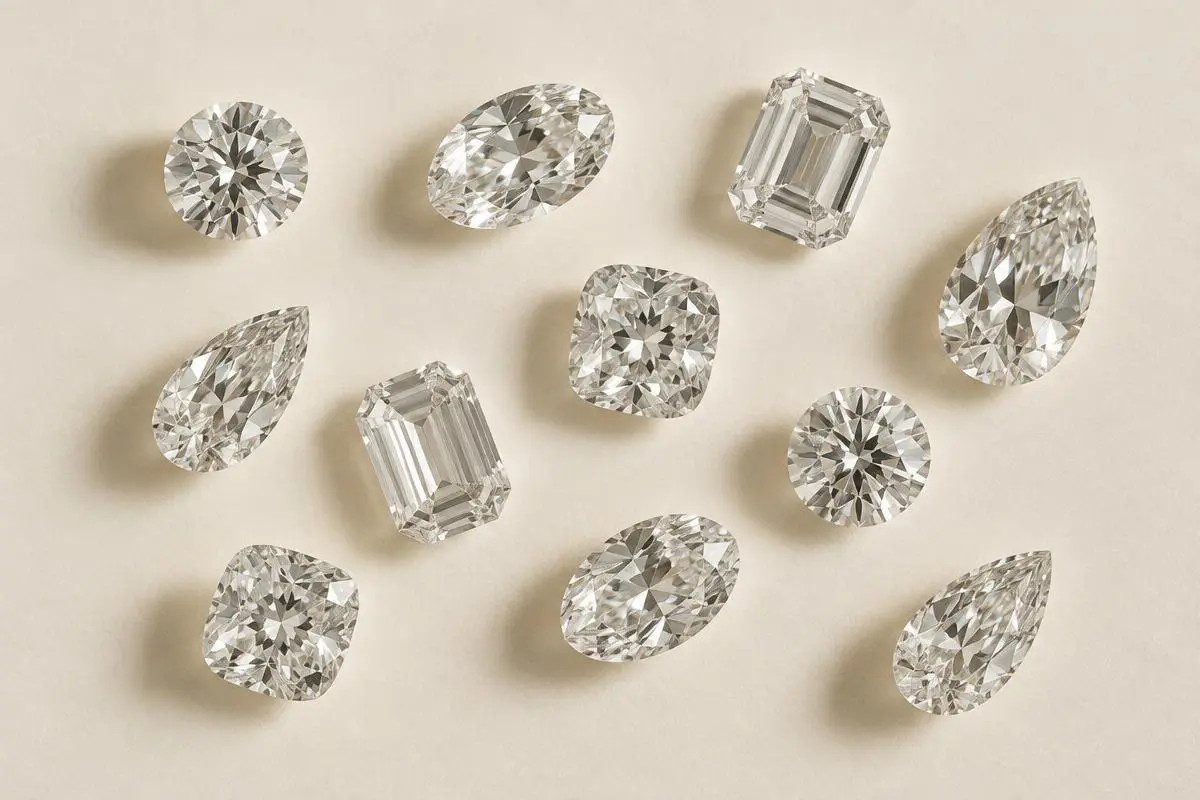
Diamond Education
The 4Cs of Diamond Quality: A Practical Buyer's Guide
How cut, color, clarity and carat weight affect a diamond's look and price, and a step-by-step way to decide which grades are worth paying for.
Updated November 13, 2026
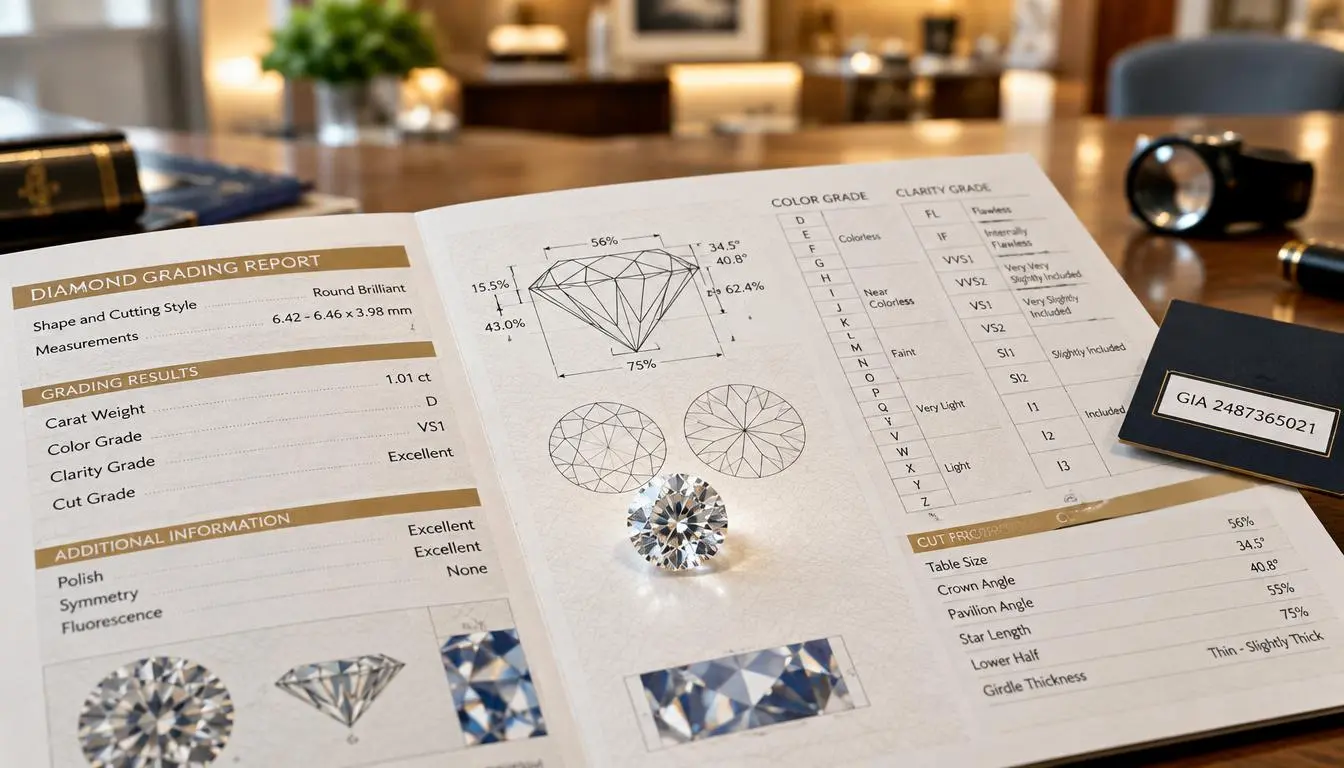
Diamond Education
Gemological institute of america diamond grading report guide
Learn what a GIA diamond grading report records and how to read its grades, clarity plot, fluorescence, and report number. Use the report alongside an in-person inspection when comparing diamonds.
Updated November 7, 2026