
Diamond Education
How Much Should You Spend on an Engagement Ring? Budget Tips
There is no universal amount to spend on an engagement ring. Learn how to set a comfortable budget, compare diamond and setting costs, and choose a payment plan that fits your finances.
By Ring Wisdom Editorial TeamPublished Updated
Affiliate disclosure: we may earn a commission from qualifying purchases through links in this article, at no extra cost to you. Learn more.
Key Takeaways
The most useful starting point is a clear personal limit, not a price tag borrowed from someone else.
- Choose a maximum that fits your finances and your partner’s preferences.
- National spending figures offer context, not a personal target.
- Carat weight measures a diamond’s weight, not its face-up size. One carat weighs 0.2 grams.
- Diamond grades, metal, and setting design all affect the total cost.
- Compare complete-ring prices and payment terms before deciding.
What Do Engagement Rings Cost in the United States?
In 2025, the average U.S. engagement-ring cost was $7,364, while the median sales price was $6,939. These figures describe what buyers paid; they are not recommended budgets.
An average is calculated from all recorded prices and can be pulled upward by higher-priced sales. The median sales price is the middle sale in an ordered set: half of sales cost more and half cost less. A median appraised replacement value is an estimate for replacing a ring, not its original purchase price.
An appraisal may estimate replacement cost through a particular retail channel. It does not show what the buyer paid or what another buyer would offer. Compare like with like when considering sales prices and appraised replacement values.
The median engagement-ring diamond size was 2.0 carats in 2025, compared with 1.01 carats in 2019. That statistic describes the median, not the size every couple chooses; sales data include different diamond origins, grades, settings, and price points.
Use market figures as context, then judge your own budget against your finances and preferences. A ring below the average can still be meaningful, and a higher price does not automatically make a ring a better fit.
- 2025 average U.S. engagement-ring cost: $7,364.
- 2025 median sales price: $6,939.
- 2025 median appraised replacement value: $9,676.
Part 1 of 7 complete
How Much Should You Spend on an Engagement Ring?
Choose a maximum that leaves room for regular expenses and financial goals, even if it is below what other couples spend. Your budget should reflect available funds and monthly cash flow, not a market average.
About two-thirds of couples spent under $6,000 on an engagement ring, and one-third spent under $3,000. These figures show a range of choices, not a recommended minimum or maximum.
Start with money you can use without missing bills or drawing down savings set aside for other needs. Consider routine expenses and planned costs such as rent, utilities, travel, or family obligations.
Set a maximum for the total ring price, not just the diamond. Include the stone, setting, taxes, and other charges. Treat the maximum as a boundary, not a target you have to reach.
Include Your Partner’s Preferences
Your partner’s preferences can change where each dollar makes the most sense. A simpler design may leave more room for a larger center stone or a different metal; someone who prefers another gemstone may want that instead of a diamond.
A stone’s apparent size depends on more than carat weight. Its shape, setting, and position can affect how it looks on the hand.
Pay attention to preferences about daily wear, metal color, and ring shape. If you are unsure, prioritize what your partner has said over assumptions about what an engagement ring should look like.
Does the Three-Month Salary Rule Still Make Sense?
The three-month-salary rule began as a De Beers advertising idea, not a personal-finance standard. In the 1930s, an advertising campaign suggested spending one month’s salary on a diamond ring; by the 1980s, the guideline had grown to two or three months’ salary.
A salary formula does not account for debt, savings goals, everyday expenses, or other commitments. Two people with the same salary can have very different amounts available after bills and obligations.
Treat the rule as advertising history, or ignore it if it does not help you make a decision. A personal limit based on your finances is more useful than a fixed salary multiple.
How Can You Set a Budget That Protects Your Finances?
Before setting a price ceiling, check whether the purchase would interrupt bills, debt payments, or savings you rely on. Keep regular expenses and important goals funded before setting aside ring money.
An emergency fund covering three to six months of expenses is one suggested safeguard, not a requirement that everyone must meet before buying a ring. Consider your own needs and resources.
In 2025, 62.5% of entries in Estate Diamond Jewelry’s engagement-ring budget calculator reported existing debt. These were calculator responses, not verified purchases or unique buyers, so the figure should not be treated as representative of all ring buyers.
A savings timeline of six to twelve months is one possible approach. Divide your savings target by the number of months and check whether that contribution is realistic. Extend the timeline or lower the target if saving would crowd out other goals.
- Regular expenses, including bills and necessary monthly costs.
- Progress on high-interest debt.
- Savings goals already in motion.
- An emergency fund for unexpected expenses.
What Makes One Engagement Ring Cost More Than Another?
A ring’s price depends on several choices, including the center diamond’s grades and weight and the setting’s metal and design. Compare each part against your spending limit before choosing a complete ring.
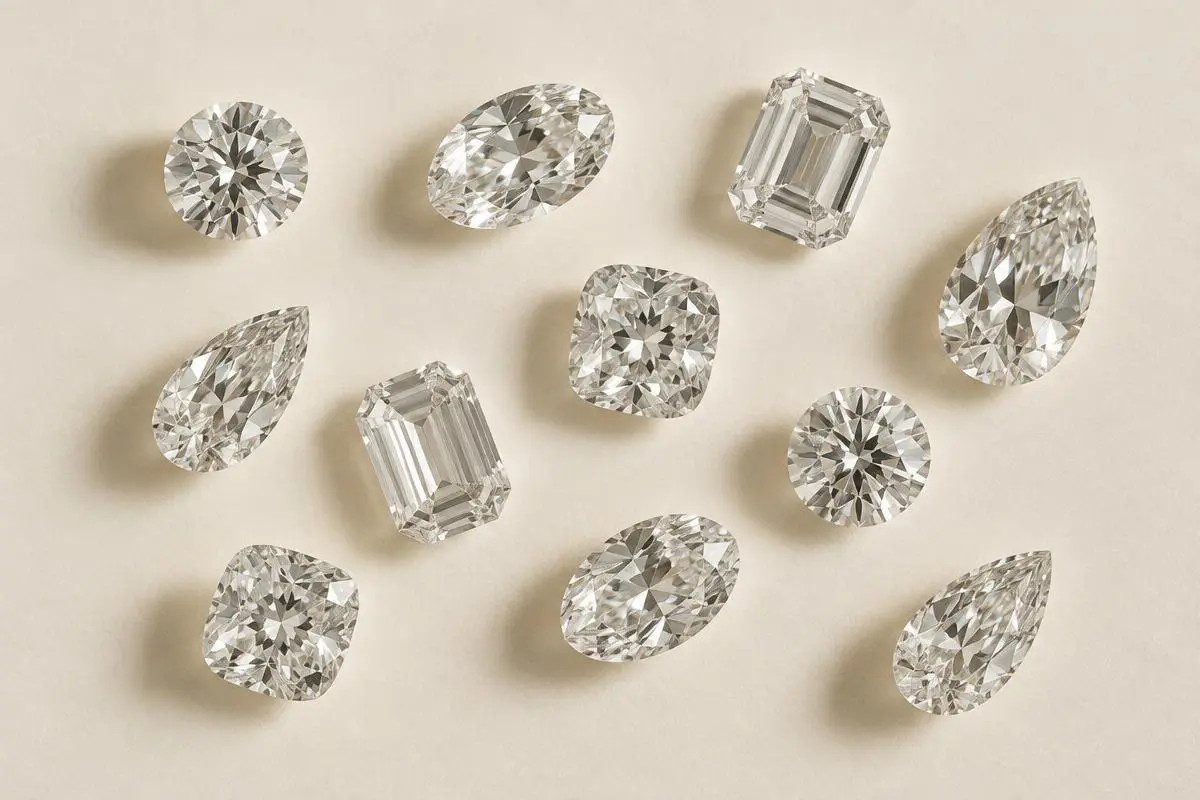
Cut describes a diamond’s proportions and light performance; shape describes its physical form, such as round, oval, or pear. A round shape is not itself a cut grade.
Color grades describe how much color a diamond shows. The scale runs from D, which is colorless, to Z, which is light yellow or brown. Compare stones under similar lighting because differences can be subtle.
Clarity grades describe internal features and surface marks. The GIA Diamond Clarity Scale has 11 grades, from Flawless (FL) to Included (I3), and grades diamonds under 10x magnification. A lower grade does not necessarily mean a feature is easy to see without magnification.
Carat weight measures a diamond’s weight, not its physical size. One carat weighs 0.2 grams. Two diamonds with the same carat weight can look different because shape and proportions affect their visible surface area.
Account for the Setting and Metal
In 2025, a 14k gold setting ranged from $1,000 to $1,700; an 18k gold setting ranged from $1,300 to $2,400; and a platinum setting ranged from $1,400 to $2,400. Metal choice affects the setting cost before a center diamond is added.
Setting style also affects the total. In 2025, solitaire settings ranged from $1,000 to $3,000; pavé from $2,000 to $5,000; and three-stone and halo settings from $2,000 to $7,000 or more.
A 1-carat lab-grown solitaire in 14k gold can cost near $2,500, while a 1-carat natural-diamond halo ring in platinum can cost more than $8,000. The stone’s origin, metal, and design choices all contribute to the difference.
Compare the whole ring, not just the center stone, before deciding whether a quoted price fits your limit.
How Do Natural and Lab-Grown Diamonds Compare in Price?
In 2025, the median sales price of a natural-diamond engagement ring was $12,961, compared with $4,557 for a lab-grown-diamond engagement ring. These medians describe sales of varied rings, not identical rings placed side by side.
The average lab-grown engagement ring cost about $4,900 in 2025, compared with roughly $7,600 for a mined-diamond ring. These averages are a different measure from the median sales prices.
The 2025 median price per carat was $8,428 for natural diamonds and $2,057 for lab-grown diamonds. For rings with diamonds in the 0.5-to-1.0-carat range, the average cost was $6,307 for natural diamonds and $3,453 for lab-grown diamonds.
These figures do not mean every lab-grown stone costs less than every natural diamond. Individual prices still reflect grades, weight, shape, and the rest of the ring. Lab-grown diamonds appeared in 51% of newly appraised U.S. engagement rings from January through June 2026.
- 2025 median engagement-ring sales price: $12,961 natural; $4,557 lab-grown.
- 2025 median price per carat: $8,428 natural; $2,057 lab-grown.
- 2025 average cost for rings in the 0.5-to-1.0-carat range: $6,307 natural; $3,453 lab-grown.
Understand the Lab-Grown Price Trend
Wholesale prices for lab-grown diamonds fell by about 26% on average in 2025. The average year-over-year decline was about 13% in Q2 2026, although changes differed by carat size.
In Q2 2026, wholesale prices for 1-carat round lab-grown diamonds rose about 1% year over year. Prices for 1.50-to-1.99-carat stones fell about 11%, and 2-carat stones fell about 20%. These are wholesale-market changes, not a promise about a retailer’s advertised price.
Choose between natural and lab-grown stones based on the origin and price trade-offs that matter to you, not on a resale assumption.
Where Can You Save Without Sacrificing the Look?
Two diamonds that look similar can have different advertised prices. Compare their specifications and the complete-ring total; a headline price is useful only when the stones and purchase terms are comparable.
In a July 23, 2026 U.S. online-market benchmark, loose 1-carat lab-grown diamonds with E color, VS1 clarity, round-brilliant shape, Excellent cut, and IGI grading were advertised for $295 to $899. These were loose-stone prices, not complete-ring prices.
With the same listed specifications, comparable 1.5-carat diamonds were advertised for $387 to $1,818, while comparable 2-carat stones ranged from $532 to $3,284. Matching carat weight and stated grades alone may not determine which listing offers the best value.
A natural diamond weighing 0.92 or 1.91 carats can often cost 10%–15% less than one at the next whole-carat mark. Once set, it may look nearly identical to the next whole-carat size.
Historically, IGI-certified diamonds cost 10%–12% less than GIA-certified diamonds with the same stated grade. In October 2025, GIA replaced its full lab-grown diamond grading scale with two descriptive tiers; read report terminology carefully when comparing lab-grown stones.
Seasonal sales around Black Friday, Cyber Week, and the period before Valentine’s Day may affect advertised prices. Compare the final price and ring details rather than assuming an event guarantees a discount.
- Compare identical specifications across retailers.
- Consider a just-under-whole-carat weight if its appearance suits you.
- Check the grading report and its terminology.
- Confirm whether the displayed price includes the setting and other costs.
- Compare complete-ring prices, not only loose-stone prices.
Should You Pay Cash, Finance, or Insure the Ring?
Paying cash avoids interest, while financing can spread the cost if the payment schedule and total terms fit your budget. A rewards card may earn points, miles, or cash back, but rewards do not erase debt. About a third of proposers finance their engagement ring; that is a common choice, not a reason to borrow.
A 0% introductory APR offer can provide time to pay without interest during the promotional period, but the balance should be cleared before that period ends to avoid later interest. Review the terms, due dates, and payoff amount.
Compare the total repayment amount, not only the monthly payment. A smaller payment stretched over a longer term can still cost more.
Engagement-ring insurance typically costs about 1%–2% of the appraised value per year. Coverage depends on the policy, so review covered losses and damage, exclusions, claim rules, and how repair or replacement is handled.
Appraisals are commonly updated every few years. Review the appraisal and policy terms to check that the insured value is current, and keep the paperwork with your important records.
- Cash avoids interest, but uses money that may be planned for other needs.
- Financing spreads payments; review the term, fees, and total amount owed.
- Rewards cards can offer benefits, but carried interest can outweigh them.
- Check insurance coverage and exclusions before relying on a policy.
Conclusion
A well-chosen ring suits your partner and your financial life at the same time. A comfortable spending ceiling matters more than an arbitrary formula, and your partner’s preferences can guide the design within that limit.
Write down the maximum total price you can spend comfortably, including the setting and other charges. Use that number to compare rings rather than letting a displayed price set your expectations.
Keep learning: read the Diamond Buying Guide, explore diamond shapes and the diamond 4Cs, browse comparisons, or see all buying advice.
Frequently asked questions
How much should you spend on an engagement ring?
There is no universal amount. Set a maximum that fits your available funds, regular expenses, savings goals, and partner’s preferences. Treat market averages as context, not as a personal target.
Is the three-month salary rule a financial guideline?
No. The rule originated in advertising and does not account for individual expenses, debt, savings, or financial goals. Use a budget based on your own circumstances instead.
Does a higher carat weight always mean a larger-looking diamond?
Not necessarily. Carat measures weight, not physical size. Shape, proportions, and setting can affect how large a diamond appears on the hand.
Are lab-grown diamonds less expensive than natural diamonds?
The 2025 median sales price for lab-grown-diamond engagement rings was lower than for natural-diamond rings, but individual prices vary with the stone’s grades, weight, shape, and setting. The reported medians do not compare identical rings.
How much does engagement-ring insurance usually cost?
The article estimates typical premiums at about 1%–2% of the appraised value per year. Actual coverage and cost depend on the policy, so review its terms, exclusions, and claim rules.
Related articles
Diamond Education
The 4Cs of Diamond Quality: A Practical Buyer's Guide
How cut, color, clarity and carat weight affect a diamond's look and price, and a step-by-step way to decide which grades are worth paying for.
Updated November 13, 2026
Comparisons
Natural vs Lab-Grown Diamonds
Compare natural and lab-grown diamond rings by origin, how they are graded and disclosed, individual diamond quality, and complete cost—not marketing claims alone.
Updated November 13, 2026