
Diamond Education
Low Profile Engagement Rings: Compare Styles and Prices
Compare low-profile engagement ring styles, starting prices, wedding-band fit, and setting details. Learn what to check for comfort, stone clearance, security, and everyday care.
By Ring Wisdom Editorial TeamPublished Updated
Affiliate disclosure: we may earn a commission from qualifying purchases through links in this article, at no extra cost to you. Learn more.
Key Takeaways
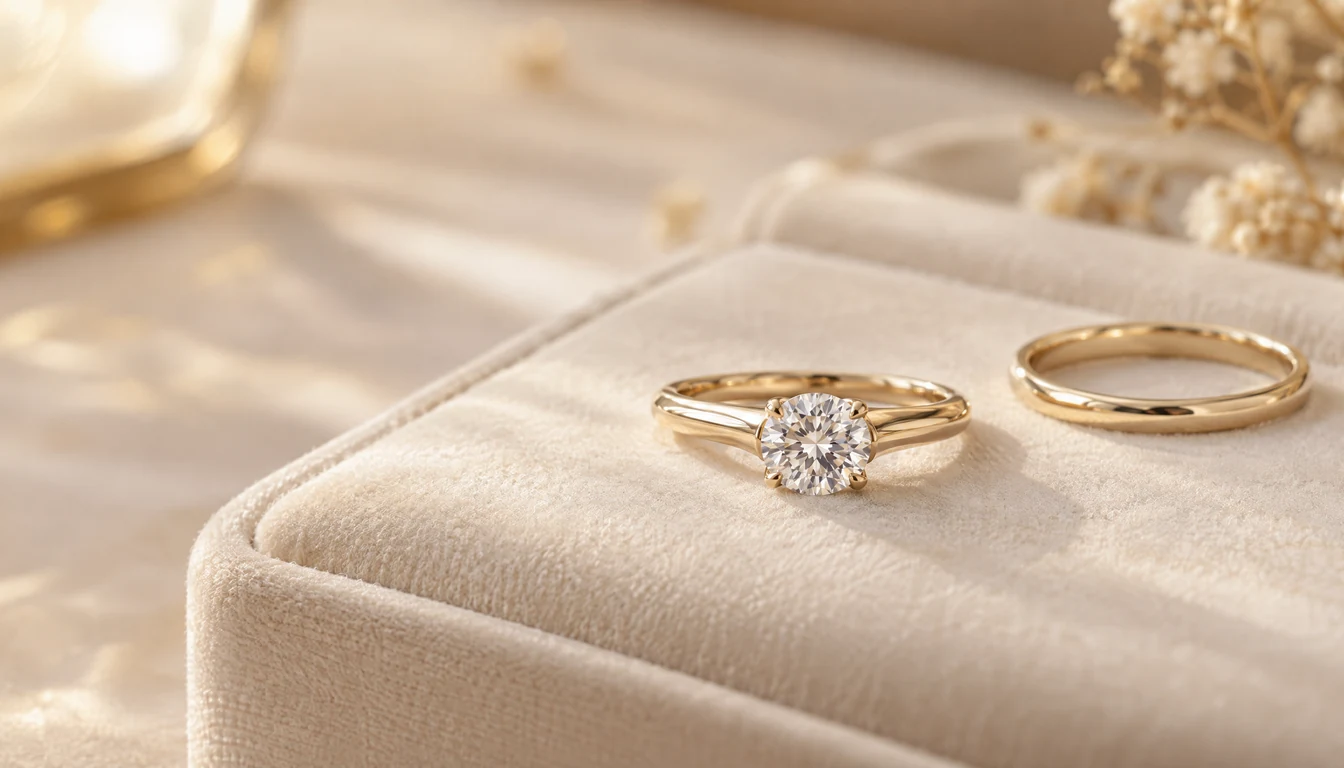
Low-profile engagement rings keep the center stone close to the finger, but style names alone do not show exactly how a ring sits. Compare the actual side profile, construction, and fit before choosing.
- Compare each ring’s side profile, not just its style name.
- Check center-stone clearance and setting construction.
- Consider how the ring fits your daily routine.
- Look at the whole design, including the band.
- Ask to see the exact ring from the side before you choose.
What Counts as a Low-Profile Setting?
A low-profile ring typically sits 6 mm or less in height, while a high-profile ring typically measures 7 mm or higher. Setting height is the vertical distance from your finger to the highest point of the center setting.
Measure from your finger to the setting’s highest point, not just to the top of the diamond. Height describes the ring’s full profile, including the parts that hold the center stone.
Height is different from the open space beneath a stone. A setting may sit low but leave room under the diamond, or sit low with little space beneath it.
The side view shows the basket, gallery, and position of the center stone. Two rings described as low set can still have different heights, shapes, and construction.
Part 1 of 5 complete
Which Styles Work Well in a Low Profile?
A solitaire gives you a clean center-stone silhouette, while a bezel, hidden halo, or pavé band adds a different design detail. Compare the complete silhouette, including the side view, because similar-looking styles can use different structures.
A solitaire keeps attention on one center stone. A bezel outlines the stone with a rim of metal, giving its edge a more defined frame. Examples include a round diamond in a bezel and a marquise set east-west in a half bezel.
A hidden halo places accent stones beneath the center diamond. The detail may be subtle from above but visible from an angled view. Pavé means small stones set into the band’s surface, adding sparkle along the band.
Center-stone shape also changes the design. An oval creates a long, smooth outline; a pear has a rounded end and a point; and a marquise has two pointed ends. An emerald cut has long, straight facets and a stepped look.
Three-stone rings place accents beside the center diamond, creating a wider face-up design. The side stones can echo the center shape or add contrast. Treat each design name as a starting point and compare its actual side profile.
How Much Do Low-Profile Engagement Rings Cost?
The article lists example starting prices from $2,950 for an open-bridge round solitaire with a hidden halo to $5,350 for a 2-carat pear halo with a pavé shank. These are prices for the listed designs, not a universal market range for all low-profile engagement rings.
Center-stone specifications, metal, accent details, and customization affect comparisons. A listed price is useful only when you compare what each ring includes, such as the center diamond and band details.
Lab-grown and natural diamonds can have different prices, but the ring’s other specifications also matter. Compare the center stone’s details and metal before weighing one design against another.
- Open-bridge round solitaire with hidden halo: starting at $2,950.
- Radiant center with hidden halo and pavé band: starting at $3,150.
- Five-stone design with emerald center: starting at $3,150.
- 2-carat pear halo with pavé shank: starting at $5,350.
- Art Deco design with princess halo, invisible setting, and milgrain: starting at $4,650.
Will Your Wedding Band Sit Flush?
A straight wedding band sits flush only when the engagement ring leaves a clear path beside and under its center setting. The basket or gallery can block that path, even on a low-set ring.
Setting height and space beneath the center both affect a flush fit. A low-profile setting may leave enough clearance for a straight band, but check the exact engagement ring and wedding band together rather than judging from separate pictures.
A curved, open, or custom band may fit around a setting that blocks a straight band. If a straight band is essential, ask to see the side view with that exact band beside the setting.
- Inspect whether the basket or gallery extends into the band’s path.
- Check the space beneath the center stone.
- Test the exact straight band against the engagement ring’s side profile.
- Consider a curved, open, or custom band if the straight band cannot sit flush.
Daily Wear, Stone Security, and Setting Types
A lower-set center stone is less likely to catch on objects. Different settings hold the diamond in different ways, which affects its exposure.
A bezel uses a wall of metal around all or part of the stone’s edge. A full bezel surrounds the perimeter, while a partial bezel leaves parts exposed. Prongs hold the center at separate contact points and can lift or bend. A flush setting places the diamond into the band to reduce its exposure.
Ask a jeweler to inspect the ring yearly, especially if it has pavé or prongs. The jeweler can check for lifted or bent prongs, loose pavé stones, movement in the center, and wear that may affect security.
A strong setting can still be affected by an impact or snag. Have it checked after a hard impact rather than waiting for the next scheduled inspection.
- Bezel: metal surrounds all or part of the stone’s edge.
- Prong: separate contact points hold the center stone; prongs can lift or bend.
- Flush: the diamond is set into the band to reduce exposure.
- Check the setting yearly and after a hard impact or snag.
Checks for Stone Depth, Cleaning, and Detail
A low-profile design still needs enough vertical clearance for the center diamond’s pavilion, the pointed underside of the stone. A deeper center may need more space than a shallower one, so setting height alone does not show whether the stone has enough room.
Prongs need suitable contact around the diamond’s girdle, the edge between its upper and lower parts. A close setting should not sacrifice steady contact just to reduce the ring’s profile.
A low-profile gallery or surrounding metal may limit access for cleaning and inspection, and there may be less room for accent stones beneath the center. A lab-grown diamond has a Mohs hardness rating of 10, the same as a natural diamond, but that does not replace sound setting construction.
The article recommends soaking a diamond ring in warm, soapy water for about 10 minutes and brushing it gently with a soft-bristled toothbrush. Deep-cleaning every two to four weeks is suggested, with extra care around pavé stones and other small details.
Some jewelry cleaners can remove rhodium plating from white gold. Check that a cleaner is compatible with the ring’s metal and finish before using it.
Compare Ring Options Before You Buy
Compare complete ring designs using the same center-stone and setting preferences. Options may include natural diamonds, lab-grown diamonds, moissanite, and colored gemstones such as teal sapphire, morganite, and salt-and-pepper diamonds.
Keep the center-stone choice and setting details together as you compare. Complete views can show how the stones, band, and setting work as a whole; a close-up of the center alone may not show the finished design.
Product names may describe a setting style without showing every stone detail. Read the listed choices for the center and accents, and confirm the exact combination you intend to purchase.
- Confirm the center-stone type.
- Record the setting style.
- Compare complete views of the designs.
- Keep the selected details together when reviewing options.
- Confirm the exact combination of center stone, side stones, and setting before buying.
Conclusion
Choose a design that suits your taste while allowing the center stone, setting, and band to work together. A ring can have the look you want and still need enough room for its stone and setting.
The best choice balances appearance, stone clearance, everyday wear, and wedding-band fit. A side view of the ring beside your chosen band can reveal a fit issue that a top view hides.
Ask the jeweler to confirm the setting height, pavilion clearance, and wedding-band fit for your chosen design before you approve it.
Keep learning: read the Diamond Buying Guide, explore diamond shapes and the diamond 4Cs, browse comparisons, or see all buying advice.
Frequently asked questions
What is considered a low-profile engagement ring?
The article describes a low-profile ring as typically 6 mm or less in height, measured from the finger to the highest point of the center setting. Check the actual ring, since labels alone do not show its exact profile.
Will a low-profile engagement ring fit flush with a wedding band?
Not always. The basket or gallery may extend into the band’s path. Test the exact engagement ring with the wedding band, and consider a curved, open, or custom band if a straight band does not sit flush.
Are low-profile rings better for everyday wear?
A lower-set center is less likely to catch on objects, which may suit some daily routines. Comfort and security also depend on the setting construction, stone clearance, and how the ring fits your activities.
Which settings can help protect a diamond?
A bezel surrounds all or part of the stone’s edge, while a flush setting places the diamond into the band. Prongs hold the stone at separate contact points and should be checked regularly for lifting or bending. The best choice depends on the ring and your priorities.
How often should an engagement ring be inspected?
The article recommends having a jeweler inspect the ring yearly, especially if it has pavé or prongs. Have it checked sooner after a hard impact or snag.
How should I clean a diamond engagement ring?
The article suggests soaking it in warm, soapy water for about 10 minutes, then gently brushing with a soft-bristled toothbrush. Check that any jewelry cleaner is compatible with the ring’s metal and finish, particularly white gold.
How much do low-profile engagement rings cost?
The article’s listed examples start at $2,950 and go up to $5,350. These are starting prices for specific designs, not a universal market range. Center-stone specifications, metal, accents, and customization affect the final price.
Related articles
Diamond Education
Oval Engagement Ring With Side Stones: Your Style Options
Explore side-stone shapes, diamond cuts, band profiles, and setting styles for oval engagement rings. Learn how to compare stone measurements and choose a balanced design.
Updated November 14, 2026
Diamond Education
The 4Cs of Diamond Quality: A Practical Buyer's Guide
How cut, color, clarity and carat weight affect a diamond's look and price, and a step-by-step way to decide which grades are worth paying for.
Updated November 13, 2026