
Diamond Education
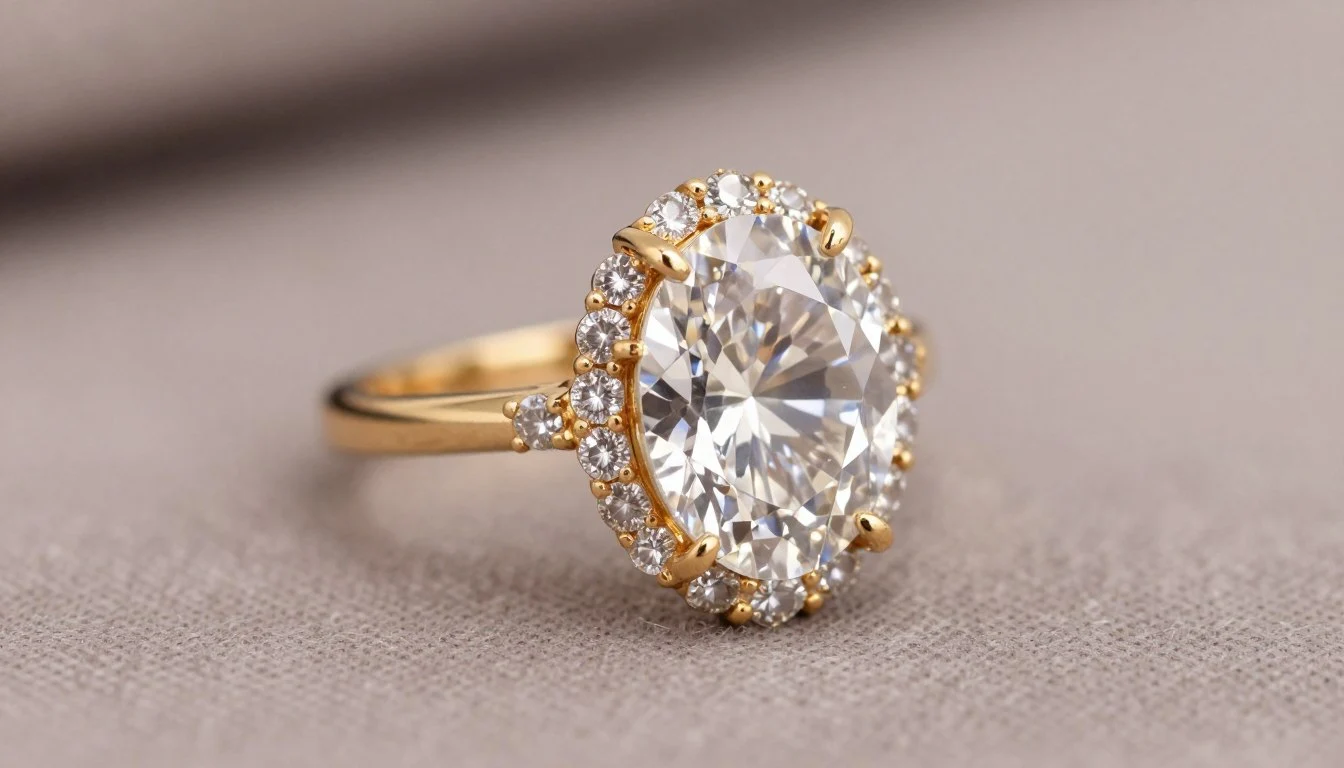
Oval Engagement Ring With Side Stones: Your Style Options
Explore side-stone shapes, diamond cuts, band profiles, and setting styles for oval engagement rings. Learn how to compare stone measurements and choose a balanced design.
By Ring Wisdom Editorial TeamPublished Updated
Affiliate disclosure: we may earn a commission from qualifying purchases through links in this article, at no extra cost to you. Learn more.
Key Takeaways
A side-stone design adds detail beside an oval center. Choose the visual effect you want rather than assuming that more stones make a setting a better match.
- Choose side-stone shapes and cuts that suit the complete design.
- Compare the center diamond’s outline and appearance, not just its ratio.
- Use millimeter measurements to judge how side stones fit the center.
- Compare complete settings before choosing a ring.
What Do Side Stones Add to an Oval Center?
Side stones give an oval center a framed, finished look and add detail along the band. They connect the center to the rest of the design without changing the center diamond itself.
A three-stone setting pairs one center stone with two side stones. Names such as “Side Stone” and “Trilogy” may also appear as separate setting-style categories, so terminology can vary by collection.
The center remains the focal point while the accents shape the design around it. A simple band may look more finished with side stones, while an already detailed band may call for restrained accents.
Look at the ring from above to see how the accents frame the oval, and from the side to see how the setting holds them. Choose side stones for the design they create; they do not guarantee that the center diamond will look larger.
- Frame the center with accents on both sides.
- Add detail beside the center rather than around it.
- Create a broader visual composition across the top of the ring.
- Balance a plain band with stones near the center.
Part 1 of 6 complete
Side-Stone Shapes for an Oval Center
Half-moon and smaller oval accents keep the side profile soft, while tapered baguettes and round accents create different outlines beside the center. The main distinction is the shape of the finished design, not a ranking of quality.
Half-moon diamonds have a curved edge that can echo the oval’s rounded form. Smaller oval diamonds repeat the center’s general shape at a reduced scale, creating a flowing transition toward the band.
Tapered baguettes add straighter lines and narrow toward the band. Round accents can add sparkle without extending the outline as far. Compare the complete three-stone silhouette, since a side stone may look different next to the oval than it does on its own.
Match Side-Stone Cuts to the Center
Start by matching the faceting style, then check whether the side-stone outline suits the center. Brilliant-cut center stones are generally complemented by brilliant-cut sides, while step-cut centers are generally complemented by step-cut sides.
Brilliant cuts use facets arranged to return light in a lively pattern. Step cuts have broader, more ordered facets. Matching these styles can make the center and accents feel related, although their shapes may still contrast.
Half-moon side stones are commonly paired with oval, round, and cushion centers. Smaller oval side stones are commonly paired with oval centers. These patterns can help narrow your options, but they do not make every combination look alike.
Inspect the pairing from more than one angle. A coordinated cut style is a useful starting point, but the finished stones still need to look balanced together.
- Brilliant center: brilliant side stones are generally complementary.
- Step-cut center: step-cut side stones are generally complementary.
- Oval center: half-moon and smaller oval accents are common pairings.
Choosing an Oval Engagement Ring With Side Stones
Start your shortlist with the oval’s outline and appearance in motion, not a ratio alone. Ratios from 1.30:1 to 1.40:1 have a gently elongated look; 1.41:1 to 1.50:1 create a longer silhouette. Above 1.50:1, an oval may show a more pronounced bow tie.
A bow tie is a dark area across an oval’s center, formed when light is blocked, including by the viewer’s head and shoulders. Its visibility can differ between stones with the same ratio. View the diamond in person or request videos, since the ratio alone cannot predict its bow tie.
Ovals are generally brilliant-cut and typically have 57 or 58 facets. Look for a symmetrical outline with smooth curves; flat or bulging shoulders can interrupt the shape.
GIA does not assign an overall cut grade to oval diamonds. Its reports include polish and symmetry grades instead. GIA rates symmetry from Excellent to Poor; Excellent or Very Good symmetry can help create a balanced appearance.
View the stone face-up under clear light, check the outline and symmetry, and observe the bow tie while the diamond moves. Small changes in viewing angle can affect what you see.
- View the stone face-up under clear light.
- Check that the outline has smooth, even curves.
- Compare symmetry from side to side.
- Observe the bow tie while the stone moves.
Compare Face-Up Size, Not Just Carat Weight
Two diamonds with the same carat weight can have different face-up presence because carat measures weight, not visible size. Shape and cut proportions affect how large a stone appears from above, so millimeter measurements can help you compare its visible footprint.
An engagement-ring size chart gives an approximate measurement of 8 × 5.5 mm for a 1-carat oval. Individual diamonds can differ, so treat a chart as a starting point rather than a promise that every 1-carat oval will look identical.
Length and width give you a clearer sense of the area the center may cover. A setting can also affect how the stone reads in the finished ring, so view the diamond in its intended setting when possible.
- Check the stone’s length in millimeters.
- Check its width in millimeters.
- Compare the outline from above.
- View the stone in its intended setting when possible.
Choose a Metal and Band Profile
The metal and band profile shape the ring’s character even when the center and side stones stay the same. Gold options include 10K, 14K, and 18K, with yellow, white, and rose gold colors. Platinum is another setting metal to consider.
Compare the metal color with the look you want from your jewelry. The band profile also changes the ring’s visual balance, especially where the band meets the center. Choose the profile and metal as part of the complete design.
A slim band can leave more visual attention on the center, while a wider band makes the band itself more present. A split shank creates a divided path toward the center; pavé adds small stones along the band.
Compare the band from above and from the side to see how it meets the setting. Decide on the metal color and band profile together so neither feels disconnected from the design.
- Gold options include 10K, 14K, and 18K.
- Gold colors include yellow, white, and rose.
- Platinum is an alternative setting metal.
- Band details may include slim or wider profiles, split shank, and pavé.
Compare Halo and Side-Stone Settings
Side stones and halos create different kinds of emphasis. Side stones sit beside the center, while a halo follows its outline around the edge. A hidden halo sits beneath the center and is not a visible ring of stones around it.
Oval settings can include solitaire, halo, three-stone, east-west, and hidden-halo styles. Each places detail in a different part of the design, so choose based on where you want the accents to appear.
A halo can make the top of the ring feel more framed than side stones alone. A hidden halo may be easier to see from the side than from above, so consider the viewing angle.
A solitaire keeps attention on one center stone. An east-west setting places the oval across the finger, while a three-stone style uses the center and two side stones.
- Do you want accents beside the center?
- Do you want a frame around the center?
- Do you want a detail tucked beneath it?
- Do you prefer an uncluttered solitaire?
Fit Side Stones to the Center Diamond
Choose the center diamond first, since the side stones need to fit its actual dimensions. Record the center’s length and width in millimeters, then use those measurements to compare possible accents. Carat weights alone are a poor way to judge fit.
A matched pair does not have to rely on equal carat weights. Compare side-stone measurements and appearance beside the center, and assess both accents together for consistency.
Look at the full ring design as well as the loose stones. The center gives you a reference for scale, while the pair needs to look balanced from side to side.
- Record the center diamond’s millimeter dimensions.
- Compare side-stone measurements against the center.
- Assess both side stones together for visual consistency.
Consider Durability for Everyday Wear
An oval’s rounded ends avoid the sharp corners found on princess and marquise cuts, but no diamond shape is immune to damage. Rounded edges may make an oval less prone to chipping than shapes with sharp corners, but they do not make it damage-proof.
GIA describes girdle thickness as Thin, Medium, or Thick. The girdle is the narrow edge around a diamond between its top and bottom. An extremely thin area may increase the risk of chipping or other damage.
The setting affects how much of the stone’s edge is exposed. Ask how the setting holds the center and whether its edges are protected. If durability is a priority, ask for the girdle description and have the setting inspected.
Compare Ring Options Before You Buy
Compare complete ring designs using the same center-stone and setting preferences. Options may include natural diamonds, lab-grown diamonds, moissanite, and colored gemstones such as teal sapphire, morganite, and salt-and-pepper diamonds.
Keep the center-stone type and setting details together as you compare. Look at complete design views, not only close-ups of the center, so you can judge how the stones, band, and setting work as a whole.
Product names may describe a setting style without showing every stone detail. Read the listed choices for the center and accents, and confirm that the exact combination is the one you intend to purchase.
- Confirm the center-stone type.
- Record the setting style.
- Compare complete views of the designs.
- Keep the selected details together when reviewing options.
Conclusion
A well-chosen design keeps the oval center recognizable while making the side stones feel intentional. Balance the center’s outline with accents that suit the setting and the full ring’s style; your preferred look matters more than the stone count.
The complete ring can look different from its individual parts. Compare the stones and band together, and request a finished-view comparison before you commit.
- Shortlist two complete settings.
- Request a finished-view comparison before buying.
- Confirm the exact center stone, side stones, and setting you intend to purchase.
Keep learning: read the Diamond Buying Guide, explore diamond shapes and the diamond 4Cs, browse comparisons, or see all buying advice.
Frequently asked questions
What side stones work well with an oval engagement ring?
Common choices include half-moon and smaller oval accents for a softer outline, tapered baguettes for straighter lines, and round accents for compact sparkle. Compare the complete ring to see which shape suits the center.
Do side stones make an oval center diamond look larger?
Not necessarily. Side stones add detail and frame the center, but they do not guarantee that it will appear larger. Judge the whole design from above and from the side.
What oval length-to-width ratio should I choose?
The article describes 1.30:1–1.40:1 as gently elongated and 1.41:1–1.50:1 as a longer silhouette. Above 1.50:1, an oval may show a more pronounced bow tie. The ratio alone cannot predict how a particular diamond will look, so view it in person or request a video.
How can I compare the visible size of oval diamonds?
Compare each diamond’s length and width in millimeters, its face-up outline, and how it looks in the intended setting. Carat weight measures weight, not visible size.
How should I choose side stones that fit the center?
Choose the center first, record its length and width in millimeters, then compare side-stone measurements and appearance against it. Assess both side stones together for balance.
Are oval diamonds resistant to chipping?
Rounded ends avoid sharp corners, but no diamond is damage-proof. Check the girdle description and how the setting protects the stone’s edges, especially if the ring will be worn every day.
Related articles
Diamond Education
The 4Cs of Diamond Quality: A Practical Buyer's Guide
How cut, color, clarity and carat weight affect a diamond's look and price, and a step-by-step way to decide which grades are worth paying for.
Updated November 13, 2026
Diamond Education
How Much Should You Spend on an Engagement Ring? Budget Tips
There is no universal amount to spend on an engagement ring. Learn how to set a comfortable budget, compare diamond and setting costs, and choose a payment plan that fits your finances.
Updated November 7, 2026