
Diamond Education
Engagement Rings with Side Stones: How to Choose the Right Design
Compare engagement rings with side stones, from oval and round diamonds to marquise, half-moon, sapphire, and emerald accents. Learn what to check before you buy.
By Ring Wisdom Editorial TeamPublished Updated
Affiliate disclosure: we may earn a commission from qualifying purchases through links in this article, at no extra cost to you. Learn more.
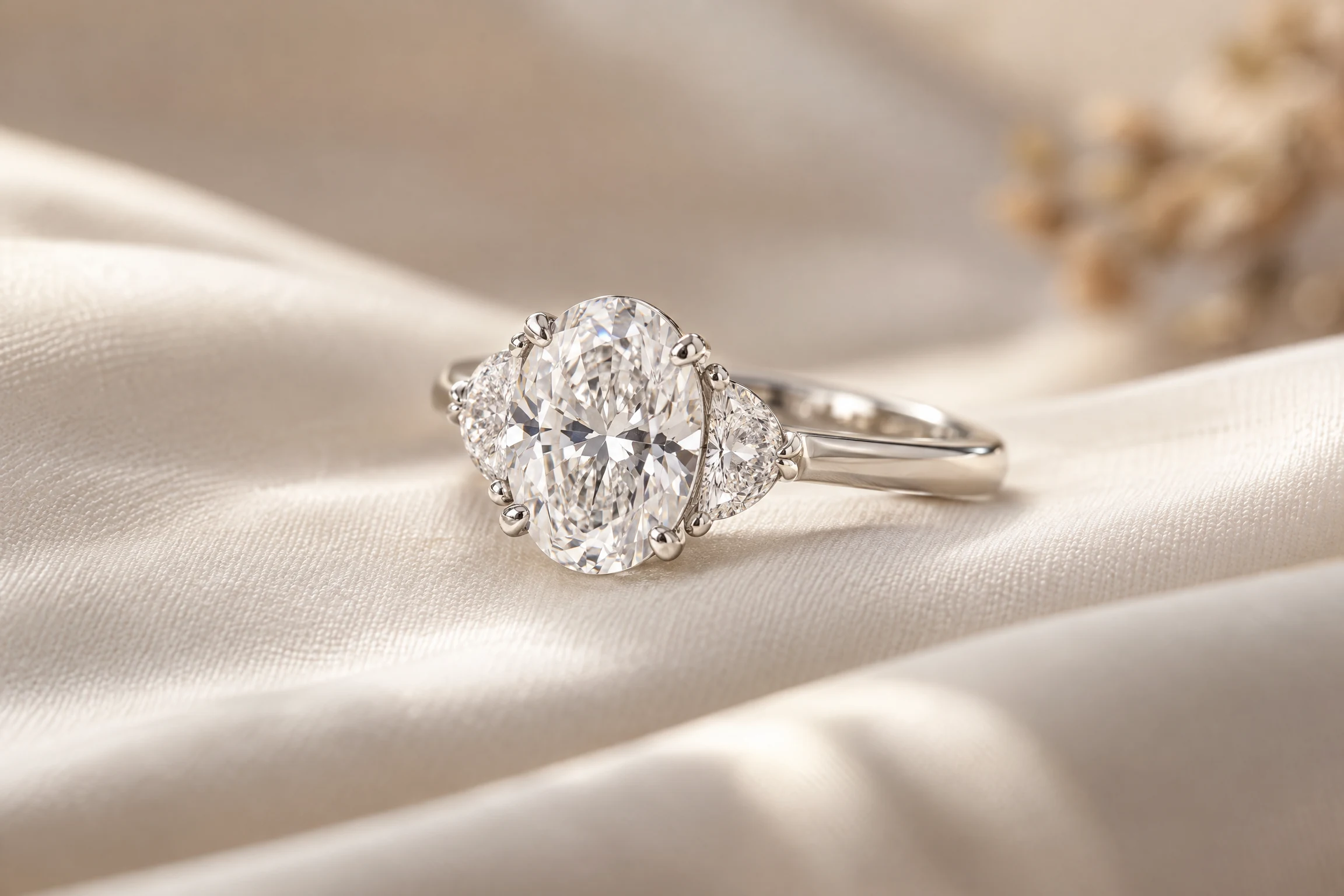
What Are Side Stones on an Engagement Ring?
An engagement ring with side stones uses smaller gemstones to frame or accent a center stone. Depending on their shape and setting, side stones can add sparkle, create contrast, emphasize the center diamond, or change the outline of the ring. They appear in many designs, including three-stone rings, rings with tapered baguettes, pavé bands, and settings with colored gemstones.
Side stones are gemstones placed beside or along the band of a ring’s center stone. They may sit as two prominent accents on either side of the center, or appear as a row of smaller stones along the shoulders or shank. Side stones can be diamonds or colored gems such as sapphires.
A three-stone ring is one recognizable type of side-stone design, but the terms are not interchangeable. Some engagement rings with side stones have many small accent diamonds along the band, while others use a pair of larger stones beside the center. GIA recommends considering the center stone, the design, proportions, and the wearer’s hand together.[1]
Popular Engagement Ring Side-Stone Styles
The best design is not simply the one with the most stones. Look at how the side stones relate to the center stone, how securely they are set, and how the ring feels on the hand. Popular designs include oval, round, marquise, half-moon, sapphire, and emerald accents.
- Oval engagement rings with side stones: Smaller oval side stones echo the center shape, while tapered baguettes or half-moon diamonds create a more defined frame. Check the combined width and make sure the accents do not overwhelm the center or extend uncomfortably across the finger.
- Round engagement rings with side stones: Round side stones create a coordinated look, while tapered baguettes or trapezoids can draw the eye toward the center. Compare the ring in more than one lighting condition.
- Engagement rings with marquise side stones: Marquise side stones add pointed, elongated accents. Check how the tips are protected and whether the setting is finished smoothly to reduce snagging.
- Oval engagement rings with half-moon side stones: Half-moon diamonds have a curved outer edge and a straighter inner edge. Beside an oval center, they can create a broad, continuous outline. Inspect the finished ring from above and from the side.
- Engagement rings with sapphire side stones: Sapphires add color beside a diamond center. Decide whether you prefer a subtle accent or strong contrast, and view the stones together in natural or neutral light.
- Emerald engagement rings with side stones: This phrase can describe either a ring with a green emerald gemstone or a ring with an emerald-cut diamond and side stones. Confirm which meaning applies to the ring you are considering.
Sapphire and Emerald Side Stones
Ask the seller to identify each gemstone accurately and disclose relevant treatments. The FTC’s Jewelry Guides say sellers should represent gemstone type, quality, color, size, weight, and treatment truthfully.[2]
GIA identifies sapphire and ruby as 9 on the Mohs hardness scale. The setting and the way a ring is worn still matter, so ask the jeweler about care for the specific gemstones in your design.[3]
A green emerald beside diamonds creates color contrast. An emerald-cut diamond center with tapered or matching side stones creates a geometric, step-cut look. Emeralds and diamonds differ in material properties, so ask about the specific stone, its setting, and care requirements.
Part 1 of 3 complete
How to Choose Side Stones That Complement the Center
The side stones should relate to the center stone in size and shape. If they are too small, they may disappear from the top view. If they are too large, they can compete with the center or make the ring feel wider than intended. GIA advises considering the wearer’s hand and the center stone’s size so the side stones are not hidden by neighboring fingers.[1]
Look at the ring from several angles. Check whether the stones sit at compatible heights and whether the transition from center to sides looks intentional. If you are ordering online, request images or video of the actual ring, not only a computer rendering.
- Compare the full ring from above and from the side.
- Check that the side stones complement rather than compete with the center.
- Confirm the measurements and shapes of every stone instead of relying only on the product title.
Check Color and Clarity as a Set
For diamond accents, consider how the side stones look next to the center diamond. The grades do not have to be identical, but an obvious color difference may stand out. GIA suggests choosing side-stone color grades that are identical or close to the center stone’s grade and making sure cut and clarity match or complement it.[1]
Ask the jeweler to show the complete ring in neutral light and explain how the grading information applies to the center and side stones. Where reports are supplied, verify which stone each report describes. GIA explains that cut, color, clarity, and carat weight work together to describe a diamond; no single grade tells the whole story.[4]
Choose a Setting That Suits Your Routine
Prongs leave more of a gemstone visible, while a bezel surrounds its edge with metal. Pavé settings place small stones along the band, and channel settings hold a row of stones between metal walls. Each construction changes the ring’s appearance and the way it should be inspected and maintained.
More stones mean more settings to keep secure. Ask a jeweler to check the prongs, channels, or other retaining parts periodically. GIA notes that settings may need care over time and that prongs can require repair or rebuilding as they wear.[5]
If you work with your hands or prefer a low-snag design, ask about lower profiles and protective settings. Follow the jeweler’s care advice for your specific gemstones and setting.
Compare the Total Price, Not Just the Center Diamond
Side stones contribute to the finished look and total ring price. Ask the seller to itemize the center stone, accent stones, setting, metal, and any service charges. Compare the actual dimensions and quality of the complete rings rather than looking only at the center stone’s carat weight.
A ring with modest side stones may have a wider visual presence than a solitaire, but the result depends on the stones’ dimensions and arrangement. If you are comparing two rings, view them side by side and check the total width, height, sparkle, and comfort.
Pros and Trade-Offs of Engagement Rings with Side Stones
Side stones offer flexibility. They can add sparkle, introduce color, frame a center diamond, or make a simple band more detailed. Shape combinations such as an oval with half-moon sides or a diamond with sapphire accents can create a distinctive design.
The trade-offs are also worth considering. Intricate settings can collect dirt more easily and may require closer inspection. A wider ring may feel different between the fingers or sit differently beside a wedding band. More stones also mean more details to verify with the seller and more settings to keep secure.
Final Checklist Before You Buy
Before choosing an engagement ring with side stones, confirm the shape and measurements of every gemstone. View the center and accents together under neutral lighting. Ask how the stones are secured and what maintenance the setting needs. Verify gemstone descriptions and treatments, compare the complete price, and try the ring with a wedding band if pairing matters to you.
The right side stones should complement the center, suit the wearer’s style, and feel practical for everyday use. Compare the actual ring—not only the product image or carat total—before making your decision.
Sources
[1] GIA, How to Select Diamond Side Stones for Engagement Rings — https://4cs.gia.edu/en-us/blog/select-diamond-side-stones-engagement-rings/
[2] Federal Trade Commission, Jewelry Guides — https://www.ftc.gov/news-events/topics/tools-consumers/jewelry-guides
[3] GIA, How to Buy a Three Stone Engagement Ring — https://4cs.gia.edu/en-us/blog/how-to-buy-three-stone-engagement-ring/
[4] GIA, Diamond Quality Factors — https://www.gia.edu/diamond-quality-factor
[5] GIA, Guide to Engagement Ring Settings — https://4cs.gia.edu/en-us/blog/guide-to-ring-settings
Keep learning: read the Diamond Buying Guide, explore diamond shapes and the diamond 4Cs, browse comparisons, or see all buying advice.
Frequently asked questions
Do side stones make an engagement ring look bigger?
They can make the overall design appear wider or more detailed, but they do not change the center diamond’s carat weight. Compare the ring’s face-up measurements and outline rather than assuming side stones make every center look larger.
Should side stones match the center diamond?
They do not have to be identical, but they should look harmonious together. Compare color, clarity, cut, and proportions as a group, and ask a jeweler to show you whether differences are noticeable in the finished ring.
Are sapphire side stones suitable for an engagement ring?
Sapphires are a popular colored-gem option. Ask about the specific sapphire, any treatments, and the setting. GIA describes sapphire as 9 on the Mohs hardness scale, but durability also depends on the gemstone’s condition, setting, and how the ring is worn.
What are the best side stones for an oval engagement ring?
There is no single best choice. Oval side stones can echo the center shape, while half-moon or tapered baguette diamonds create a more distinct outline. Compare the finished rings on the hand and choose the proportions you prefer.
Do engagement rings with side stones need extra maintenance?
They may need careful periodic inspection because they have more stones and retaining parts than a simple solitaire. Ask a jeweler to check that the stones are secure and follow the seller’s care instructions.
Related articles
Diamond Education
Three-Stone Engagement Rings: How to Choose the Right Design
Compare three-stone engagement rings by diamond shape, proportions, setting, and budget. Explore popular styles and learn how to pair your ring with a wedding band.
Updated November 16, 2026
Diamond Education
The 4Cs of Diamond Quality: A Practical Buyer's Guide
How cut, color, clarity and carat weight affect a diamond's look and price, and a step-by-step way to decide which grades are worth paying for.
Updated November 13, 2026
Engagement Ring Shopping
How to Choose an Engagement Ring: 5 Setting Styles Compared
Compare solitaire, halo, hidden halo, bezel and vintage-inspired settings by look, security, upkeep and total cost, then use a simple scoring framework to pick between your finalists.
Updated November 13, 2026
Diamond Education
Diamond Clarity Chart: How to Read Diamond Grades
Understand the 11 GIA diamond clarity grades, what inclusions and blemishes mean, and how to compare a report with the stone you may buy. Learn why the highest grade is not automatically the right choice.
Updated November 7, 2026